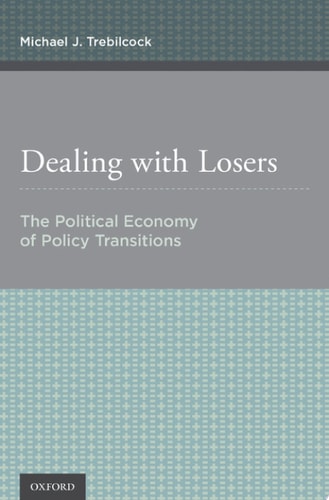
Dealing with Losers: The Political Economy of Policy Transitions
0
0
As an Amazon Associate and affiliate partner, Menrva Books earns from qualifying purchases. Learn more
Author Description
Whenever governments change policies--tax, expenditure, or regulatory policies, among others--there will typically be losers: people or groups who relied upon and invested in physical, financial, or human capital predicated on, or even deliberately induced by the pre-reform set of policies. The issue of whether and when to mitigate the costs associated with policy changes, either through explicit government compensation, grandfathering, phased or postponed implementation, is ubiquitous across the policy landscape. Much of the existing literature covers government takings, yet compensation for expropriation comprises merely a tiny part of the universe of such strategies.Dealing with Losers: The Political Economy of Policy Transitions explores both normative and political rationales for transition cost mitigation strategies and explains which strategies might create an aggregate, overall enhancement in societal welfare beyond mere compensation. Professor Michael J. Trebilcock highlights the political rationales for mitigating such costs and the ability of potential losers to mobilize and obstruct socially beneficial changes in the absence of well-crafted transition cost mitigation strategies. This book explores the political economy of transition cost mitigation strategies in a wide variety of policy contexts including public pensions, U.S. home mortgage interest deductions, immigration, trade liberalization, agricultural supply management, and climate change, providing tested examples and realistic strategies for genuine policy reform.
Menrva's Summary
THE THESIS
This book investigates the normative and political rationales for mitigating transition costs when government policy shifts create economic losers. Michael J. Trebilcock, a professor of law and economics, examines the mechanisms through which governments can manage the fallout of regulatory or fiscal reform. He argues that without well-crafted mitigation strategies, those negatively affected by policy changes possess the political capital to mobilize and obstruct reforms that would otherwise provide aggregate societal benefits.
THE SCOPE MAP
What You Will Find
- Analysis of transition cost mitigation strategies including compensation, grandfathering, and phased implementation.
- Examination of political economy factors that influence policy reform success.
- Case studies covering public pensions, U.S. mortgage interest deductions, immigration, trade liberalization, and climate change.
Scope Limits
- The text focuses primarily on the political and economic rationales for mitigation rather than providing a legal manual for litigation.
- It does not offer a universal solution for every policy context, acknowledging that strategies must be tailored to specific sectors.
THE AUTHORITY PERSPECTIVE
Experts identify this work as a significant contribution to the study of regulatory reform and the political barriers to economic efficiency. Readers frequently note the academic rigor of the prose and the practical utility of the case studies provided by the author.
Page Count:
240
Publication Date:
2015-09-01
Publisher:
Oxford University Press
ISBN-10:
0190456949
ISBN-13:
9780190456948
Economics
Public Policy
Governance
Community Tags
Similar Books