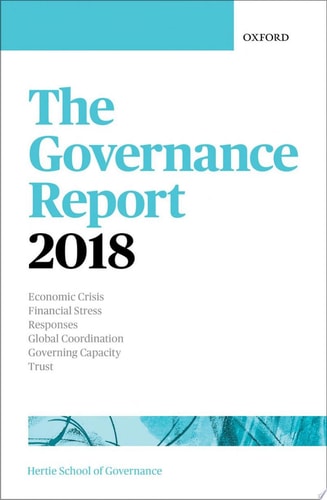
The Governance Report 2018
0
0
As an Amazon Associate and affiliate partner, Menrva Books earns from qualifying purchases. Learn more
Author Description
The Global Financial Crisis (gfc) Of 2008-9 Was The Greatest Economic Stress Test Since The 1940s. It Put Not Only Financial Markets And Currencies At Risk; Entire Economies And Political Systems Were Threatened As The Gfc Soon Revealed Major Governance Shortcomings And Weaknesses Felt Across A Wide Spectrum Of Policy Fields. Globalization Seemed In Jeopardy, The Washington Consensus Of Neoliberal Policies Broken, And Democratic Backsliding Set In As Populism And Protectionism Began To Take Root. The Gfc Triggered Many Responses To Improve Governance Through Reforms And Regulatory Measures Of Many Kinds Across A Wide Range Of Fields: Most Prominently In Finance And Banking, But Also In Fiscal Policy, Trade, Labor Markets And Social Security. Ten Years After The Gfc, The 2018 Governance Report Takes Stock And Asks: How Have Countries Fared, And Are They Better Prepared To Avoid Or Withstand Another Crisis Of Gfc Proportions? To Answer This Question, The 2018 Report Focuses On The Performance Of Countries Before And After The Gfc. Using Elaborate Indicator And Data Systems, Applying State-of-the-art Analytics, And Covering A Wide Range Of Countries, It Offers A Systematic Comparison Of Governance Performance From Three Perspectives: What Public Goods Are Being Provided, At What Quality And To What Effect? How Ready Are Countries To Address Governance Challenges In The Context Of Globalization? What Are The Administrative Capacities Of The Public Sector? With Measures Taken Before The Gfc And Today, These Perspectives On Governance Performance Provide Important Benchmarks For Measuring Both Resilience And Progress And Can Assist Policymakers In Designing Effective Solutions.
Menrva's Summary
THE THESIS
This report investigates whether nations have successfully improved their governance structures and resilience in the decade following the 2008-2009 Global Financial Crisis. The Hertie School of Governance utilizes a team of policy experts and researchers to evaluate the efficacy of post-crisis regulatory reforms. By applying rigorous analytical frameworks to longitudinal data, the report assesses whether current administrative capacities and public good provisions are sufficient to withstand future systemic economic shocks.
THE SCOPE MAP
What You Will Find
- Comparative analysis of governance performance across a diverse range of international economies.
- Quantitative indicator systems measuring public good provision and quality.
- Assessment frameworks for administrative capacity and globalization readiness.
Scope Limits
- The report does not provide specific policy prescriptions for individual non-participating nations.
- Analysis is restricted to the decade immediately following the 2008 financial crisis.
THE AUTHORITY PERSPECTIVE
Experts and policymakers frequently cite this report as a comprehensive benchmarking tool for evaluating national resilience in the post-crisis era. Readers often note the high density of the data-driven prose, which is intended primarily for an audience of academics and professional policy analysts.
Page Count:
192
Publication Date:
2018-01-01
Publisher:
Oxford University Press
ISBN-10:
0192554638
ISBN-13:
9780192554635
Economics
Governance
Financial History
Public Policy
Global Studies
Community Tags
Other Editions(3)

Similar Books
Reader Comments
Share Your Thoughts
No comments yet. Be the first to share your thoughts!