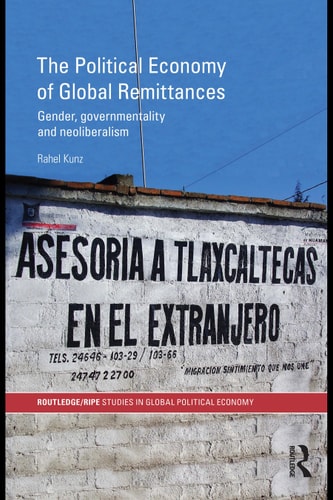
The Political Economy of Global Remittances: Gender, Governmentality and Neoliberalism
0
0
As an Amazon Associate and affiliate partner, Menrva Books earns from qualifying purchases. Learn more
Author Description
Over The Last Decade, A New Phenomenon Has Emerged Within The International Community: The Global Remittances Trend (grt). Thereby, Government Institutions, International (financial) Organisations, Ngos And Private Sector Actors Have Become Interested In Migration And Remittances And Their Potential For Poverty Reduction And Development, And Have Started To Devise Institutions And Policies To Harness This Potential. This Book Employs A Gender-sensitive Governmentality Analysis To Trace The Emergence Of The Grt, To Map Its Conceptual And Institutional Elements, And To Examine Its Broader Implications. Through An Analysis Of The Grt At The International Level, Combined With An In-depth Case Study On Mexico, This Book Demonstrates That The Grt Is Instrumental In Spreading And Deepening Specific Forms Of Gendered Neoliberal Governmentality. This Innovative Book Will Be Of Interest To Students And Scholars Of Political Science, International Relations, Sociology, Development Studies, Economics, Gender Studies And Latin American Studies.
Menrva's Summary
THE THESIS
This book investigates the emergence of the Global Remittances Trend (GRT) and its role in propagating specific forms of gendered neoliberal governmentality. Author Rahel Kunz utilizes a gender-sensitive governmentality framework to analyze how international organizations, government institutions, and private actors have institutionalized migration and remittances as tools for development. By examining the conceptual and institutional architecture of the GRT, the text argues that these policies are not neutral development strategies but are instead mechanisms that deepen neoliberal governance structures.
THE SCOPE MAP
What You Will Find
- A comprehensive analysis of the Global Remittances Trend (GRT) within international financial organizations and NGOs.
- A detailed case study focusing on the implementation and impact of remittance policies in Mexico.
- A theoretical framework applying gender-sensitive governmentality to migration and development studies.
- An examination of how neoliberal policies influence gender roles and economic agency at the international and local levels.
THE AUTHORITY PERSPECTIVE
Scholars in international relations and development studies identify this work as a critical contribution to the intersection of gender, migration, and political economy. Readers frequently note the academic density of the prose and the rigor of the author's institutional analysis.
Page Count:
220
Publication Date:
2011-01-01
Publisher:
Routledge
ISBN-10:
0203816714
ISBN-13:
9780203816714
Economics
Gender Studies
International relations
Sociology
Community Tags
Similar Books