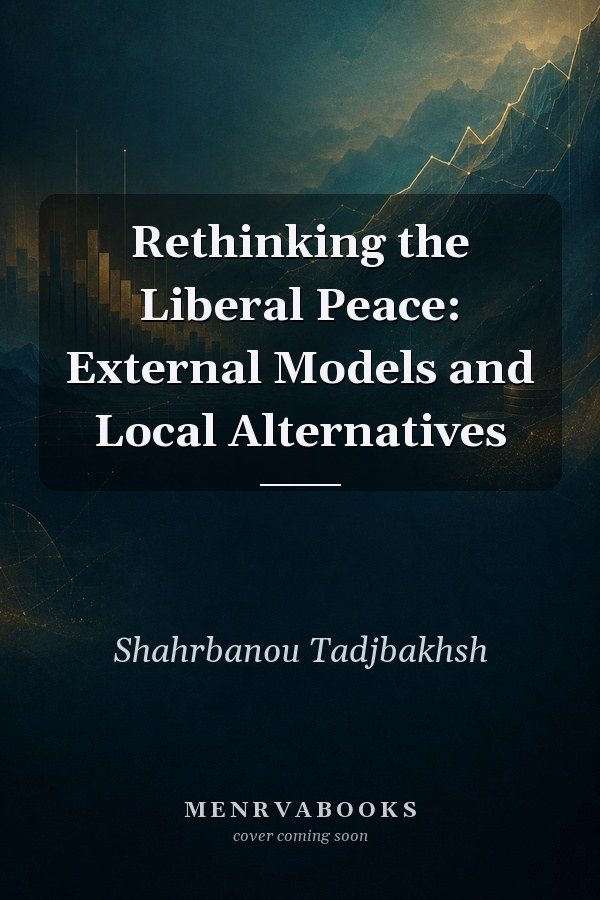
Rethinking the Liberal Peace: External Models and Local Alternatives
0
0
As an Amazon Associate and affiliate partner, Menrva Books earns from qualifying purchases. Learn more
Author Description
Machine Generated Contents Note: Pt. I Theory And Critics Of The Liberal Peace -- 1. Open Societies, Open Markets: Assumptions And Illusions / Shahrbanou Tadjbakhsh -- 2. Becoming Liberal, Unbecoming Liberalism: Liberal--local Hybridity Via The Everyday As A Response To The Paradoxes Of Liberal Peacebuilding / Oliver P. Richmond -- 3. Peace, Self-governance And International Engagement: From Neo-colonial To Post-colonial Peacebuilding / Kristoffer Liden -- Pt. Ii Liberal Democracy -- 4. The Liberal Peace: Statebuilding, Democracy And Local Ownership / David Chandler -- 5. Democracy And Security: A Shotgun Marriage? / Robin Luckham -- 6. What's Law Got To Do With It? The Role Of Law In Post-conflict Democratization And Its (flawed) Assumptions / Michael Schoiswohl -- 7. No Such Thing As Cosmopolitanism: Field-dependent Consequences In International Administrative Governance And Criminal Justice / Nicholas Dorn -- Pt. Iii Market Liberalism -- 8. Curing Strangeness In The Political Economy Of Peacebuilding: Traces Of Liberalism And Resistance / Michael Pugh -- 9. Economic Dimensions Of The Liberal Peace And Its Implications For Conflict In Developing Countries / Syed Mansoob Murshed -- Pt. Iv Case Studies -- 10. Reconstructing Post-2006 Lebanon: A Distorted Market / Roger Macginty -- 11. Is Liberal Democracy Possible In Iraq? / Patrick Tom -- 12. Liberal Peace And The Dialogue Of The Deaf In Afghanistan / Shahrbanou Tadjbakhsh -- Conclusion: Typologies And Modifications Proposed By Critical Approaches / Oliver P. Richmond. Edited By Shahrbanou Tadjbakhsh.
Menrva's Summary
THE THESIS
This collection investigates the efficacy and underlying assumptions of the liberal peace model in post-conflict societies, questioning whether external democratic and market-based interventions effectively foster sustainable stability. Edited by Shahrbanou Tadjbakhsh, the volume compiles contributions from various scholars who analyze the friction between international peacebuilding agendas and local socio-political realities. By examining the theoretical foundations of liberal interventionism, the authors argue that top-down approaches often fail to account for indigenous governance structures and economic contexts. The text serves as a critical evaluation of the mechanisms used by international actors to reconstruct states after conflict.
THE SCOPE MAP
What You Will Find
- Theoretical critiques of liberal peacebuilding and the paradoxes of external intervention.
- Analysis of the intersection between democracy, security, and the rule of law in post-conflict environments.
- Examination of market liberalism and its economic implications for developing nations.
- Case studies focusing on Lebanon, Iraq, and Afghanistan to illustrate the practical limitations of the liberal model.
THE AUTHORITY PERSPECTIVE
Experts identify this volume as a significant contribution to the critical school of international relations and peacebuilding studies. Readers frequently note the academic density of the prose, which makes it a valuable resource for researchers and students analyzing the complexities of international statebuilding efforts.
Page Count:
251
Publication Date:
2011-01-01
Publisher:
Routledge
ISBN-10:
0203819055
ISBN-13:
9780203819050
Economics
International relations
Peace studies
Sociology
Democracy
Community Tags
Similar Books