Social and political thought of Julius Evola
0
0
As an Amazon Associate and affiliate partner, Menrva Books earns from qualifying purchases. Learn more
Author Description
Julius Evola's writing covered a vast range of subjects, from a distinctive and categorical ideological outlook and has been extremely influential on a significant number of extreme right thinkers, activists and organisations. This book is the first full length study in English to present his political thought to a wider audience, beyond that of his followers and sympathisers, and to bring into the open the study of a neglected strand of contemporary Western thought, that of traditionalism. Evola deserves more attention because he is an influential writer. His following comes from an important if largely ignored political movement: activists and commentators whose political positions are, like his, avowedly traditionalist, authoritarian, anti-modern, anti-democratic and anti-liberal. With honourable exceptions, contemporary academic study tends to treat these groups as a minority within a minority, a sub-species of Fascism, from whom they are held to derive their ideas and their support. This work seeks to bring out more clearly the complexity of Evola's post-war strategy, so as to explain how he can be adopted both by the neo-fascist groups committed to violence, and by groups such as the European New Right whose approach is more aimed at influence from within liberal democracies. Furlong also recognises the relevance of Evola's ideas to anti-globalisation arguments, including a re-examination of his arguments for detachment and spontaneism (apolitia).
Menrva's Summary
THE THESIS
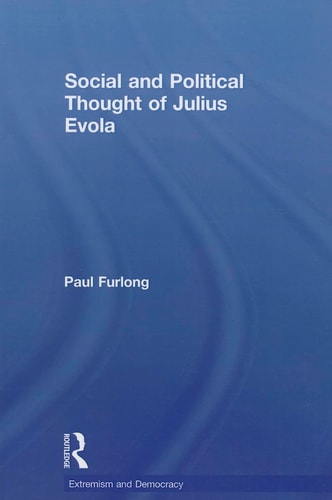
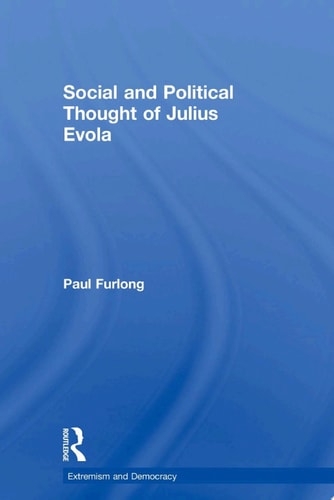
This book investigates the ideological framework and political influence of Julius Evola, a central figure in the development of contemporary traditionalist and extreme-right thought. Paul Furlong, a scholar of European politics, provides a comprehensive analysis of Evola's post-war strategies and his enduring impact on anti-modernist movements. By examining Evola's writings, Furlong argues that traditionalism represents a distinct and complex strand of Western thought that requires academic scrutiny beyond its typical classification as a mere subset of Fascism.
THE SCOPE MAP
What You Will Find
- An analysis of Evola's traditionalist, anti-democratic, and anti-liberal political philosophy.
- A study of the reception of Evola's ideas among both violent neo-fascist groups and the European New Right.
- An examination of Evola's relevance to modern anti-globalization discourse and the concept of apoliteia.
- A contextualization of Evola's work within the broader history of 20th-century political extremism.
THE AUTHORITY PERSPECTIVE
Experts recognize this work as a foundational academic study that brings necessary critical attention to a previously neglected area of political theory. Readers frequently note the objective, analytical tone Furlong employs to dissect highly controversial and polarizing ideological material.
Page Count:
176
Publication Date:
2011-01-01
Publisher:
Routledge
ISBN-10:
0203816919
ISBN-13:
9780203816912
History
Science
Art
Biography
Philosophy
Political Theory
Political and social views
Community Tags
Other Editions(6)


Similar Books



Reader Comments
Share Your Thoughts
No comments yet. Be the first to share your thoughts!