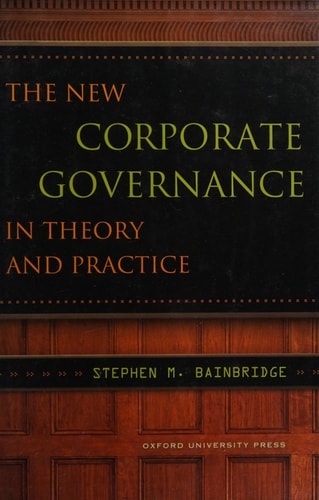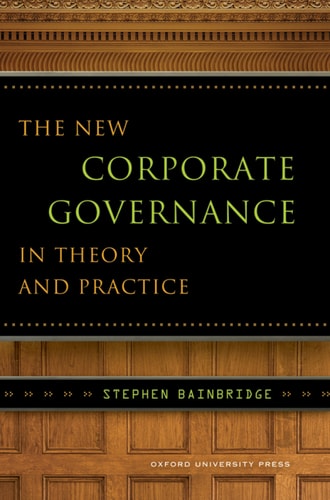
The New Corporate Governance in Theory and Practice
0
0
As an Amazon Associate and affiliate partner, Menrva Books earns from qualifying purchases. Learn more
Author Description
Forty years ago, managerialism dominated corporate governance. In both theory and practice, a team of senior managers ran the corporation with little or no interference from other stakeholders. Shareholders were essentially powerless and typically quiescent. Boards of directors were little more than rubber stamps. Today, the corporate governance landscape looks vastly different. The fall-out from the post-Enron scandal and implementation of the Sarbanes-Oxley Act have resulted in shareholder activism becoming more widespread, while many observers call for even greater empowerment. The notion that the board of directors is a mere pawn of top management is increasingly invalid, and as a result, modern boards of directors typically are smaller than their antecedents, meet more often, are more independent from management, own more stock, and have better access to information. The New Corporate Governance in Theory and Practice offers an interdisciplinary analysis of the emerging board-centered system of corporate governance. It draws on doctrinal legal analysis, behavioral economic insights into how individuals and groups make decisions, the work of new institutional economics on organizational structure, and management studies of corporate governance. Using those tools, Stephen Bainbridge traces the process by which this new corporate governance system emerged, and explores whether such changes are desirable or effective.
Menrva's Summary
THE THESIS
This book investigates the shift from managerialism to a board-centered system of corporate governance and evaluates the efficacy of this transition. Stephen Bainbridge, a professor of law, utilizes a multidisciplinary framework to analyze the evolution of corporate oversight. By integrating legal doctrine, behavioral economics, and institutional theory, the author examines how modern boards have moved away from being passive entities toward becoming active, independent monitors of corporate management.
THE SCOPE MAP
What You Will Find
- Analysis of the post-Enron regulatory environment and the Sarbanes-Oxley Act
- Behavioral economic insights regarding group decision-making processes
- Examination of the structural changes in modern boards, including size, independence, and stock ownership
Scope Limits
- The text focuses primarily on the United States corporate landscape
- It does not provide a comprehensive guide to day-to-day corporate management operations
THE AUTHORITY PERSPECTIVE
Legal scholars and business professionals frequently cite this work as a foundational text for understanding the transition toward board-centric governance models. Readers often note the academic density of the prose, which effectively bridges the gap between legal theory and practical corporate application.
Page Count:
260
Publication Date:
2008-01-01
Publisher:
Oxford University Press
ISBN-10:
0190450746
ISBN-13:
9780190450748
Business
Economics
Professional Career & Trade
Management
Corporate governance
Law
Corporate Law