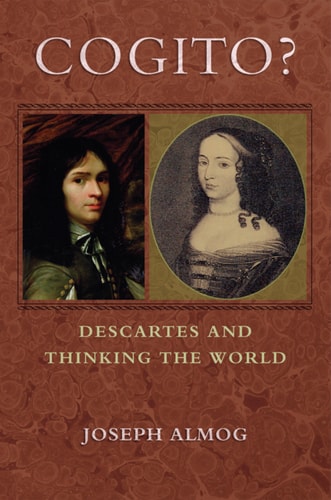
Cogito?: Descartes and Thinking the World
0
0
As an Amazon Associate and affiliate partner, Menrva Books earns from qualifying purchases. Learn more
Author Description
Decartes' maxim Cogito, Ergo Sum (from his Meditations) is perhaps the most famous philosophical expression ever coined. Joseph Almog is a Descartes analyst whose last book WHAT AM I? focused on the second half of this expression, Sum--who is the "I" who is existing-and-thinking and how does this entity somehow incorporate both body and mind? This volume looks at the first half of the proposition--cogito. Almog calls this the "thinking man's paradox": how can there be, in the the natural world and as part and parcel of it, a creature that... thinks? Descartes' proposition declares that such a fact obtains and he maintains that it is self-evident; but as Almog points out, from the point of view of Descartes' own skepticism, it is far from obvious that there could be a thinking-man. How can it be that a thinking human be both part of the natural world and yet somehow distinct and separate from it? How did "thinking" arise in an otherwise "thoughtless" universe and what does it mean for beings like us to be thinkers? Almog goes back to the Meditations, and using Descartes' own aposteriori cognitive methodology--his naturalistic, scientific, approach to the study of man--tries to answer the question.
Menrva's Summary
THE THESIS
This volume investigates the ontological paradox of how a thinking entity can exist as a constituent part of the natural, physical world. Joseph Almog, a specialist in Cartesian philosophy, utilizes the Meditations as a primary source to examine the tension between Descartes' claim of self-evident thought and the skepticism inherent in his own methodology. The author argues that by applying Descartes' naturalistic, scientific approach to the study of humanity, one can reconcile the existence of the thinking subject within a universe that otherwise lacks cognitive properties.
THE SCOPE MAP
What You Will Find
- An analysis of the 'cogito' component of Descartes' famous proposition.
- A methodological framework based on Descartes' aposteriori cognitive approach.
- Philosophical inquiry into the integration of mind and body within a naturalistic context.
Scope Limits
- The text does not provide a comprehensive biography of Descartes.
- It does not focus on the 'sum' (the 'I') which was the subject of the author's previous work.
THE AUTHORITY PERSPECTIVE
Scholars and students of philosophy frequently note the rigorous, analytical nature of Almog's prose as he navigates complex Cartesian dualism. Experts highlight this work as a focused contribution to the ongoing debate regarding the intersection of naturalism and the philosophy of mind.
Page Count:
132
Publication Date:
2008-01-01
Publisher:
Oxford University Press
ISBN-10:
0190450754
ISBN-13:
9780190450755
Philosophy
Thought And Thinking
René Descartes
Epistemology
Mind & Body
Metaphysics
History & Surveys
Philosophy history
Community Tags
Similar Books