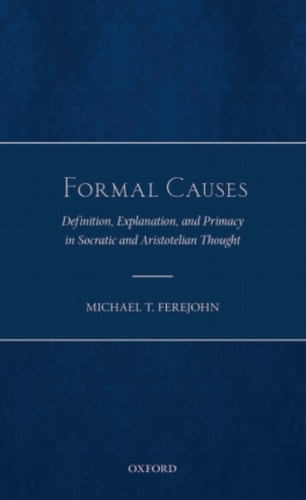
Formal Causes: Definition, Explanation, and Primacy in Socratic and Aristotelian Thought
0
0
As an Amazon Associate and affiliate partner, Menrva Books earns from qualifying purchases. Learn more
Author Description
Michael T. Ferejohn presents an original interpretation of key themes in Aristotle's classic works, and their roots in Socratic thought. The principal historical thesis of this work is that Aristotle's commendation of the historical Socrates for 'being the first to pursue universal definitions' is explainable in part by Aristotle's own attraction to the 'formal cause' (or definition-based) mode of explanation as providing justification for scientific knowledge. After exploring the motives behind Socrates' search for definitions of the ethical virtues, Ferejohn argues that Aristotle's commitment to the centrality of formal cause explanation in the theory of demonstration he advances in the Posterior Analytics is at odds with his independent recognition that natural phenomena are best explained by reference to efficient causes. Ferejohn then argues that this tension is ultimately resolved in Aristotle's later scientific works, when he abandons this commitment and instead evinces a marked preference for explanation of natural phenomena in terms of efficient as well as so-called final (teleological) causes. This tension between formal and efficient cause explanations is especially evident in Aristotle's discussions of events such as thunder and eclipses in Posterior Analytics B 8-10. In the later chapters of the book Ferejohn defends a novel interpretation of Aristotle's manner of treating these phenomena that depends on his fourfold classification of scientific questions and the presupposition relations he believes to hold among them. The final chapter turns to the role of definition in Aristotle's mature ontology. Ferejohn argues that in Metaphysics Z 17 he proposes a treatment of kinds of composite substances parallel to that of thunder and eclipses in the Posterior Analytics, and that this treatment is a crucial element in his sustained argument in Metaphysics Z and H that such kinds are definable unities.
Menrva's Summary
THE THESIS
This work investigates how the Socratic pursuit of universal definitions informs Aristotle's development of the formal cause as a primary mode of scientific explanation. Michael T. Ferejohn, a scholar of ancient philosophy, utilizes a rigorous analysis of Aristotle's Posterior Analytics and Metaphysics to trace the evolution of causal theory. He argues that Aristotle initially prioritizes formal causes in his theory of demonstration, only to later reconcile this with the necessity of efficient and final causes in his mature scientific and ontological frameworks.
THE SCOPE MAP
What You Will Find
- Analysis of Socratic ethical definitions and their influence on Aristotelian logic
- Examination of the tension between formal, efficient, and final causes in natural science
- Detailed study of Aristotle's treatment of thunder and eclipses in Posterior Analytics B 8-10
- Interpretation of Metaphysics Z and H regarding composite substances
Scope Limits
- The text does not provide a comprehensive overview of all Aristotelian causes
- It focuses specifically on the intersection of definition and causality rather than Aristotle's political or aesthetic theories
THE AUTHORITY PERSPECTIVE
Scholars recognize this text as a specialized contribution to the study of Aristotelian causality and the history of logic. Readers frequently note the academic density of the prose, which is intended for advanced students and researchers in the field of ancient philosophy.
Page Count:
224
Publication Date:
2013-01-01
Publisher:
OUP Oxford
ISBN-10:
0191502480
ISBN-13:
9780191502484
Philosophy
Metaphysics
Epistemology
Philosophy history
Knowledge Theory
History & Surveys
Community Tags
Other Editions(2)

Similar Books


Reader Comments
Share Your Thoughts
No comments yet. Be the first to share your thoughts!