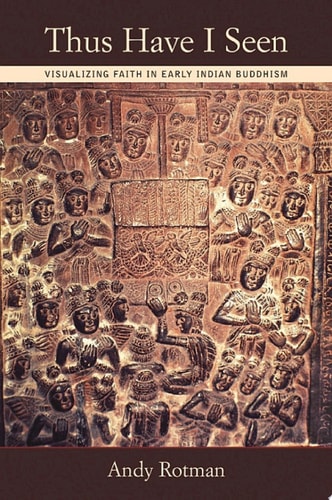
Thus Have I Seen: Visualizing Faith in Early Indian Buddhism
0
0
As an Amazon Associate and affiliate partner, Menrva Books earns from qualifying purchases. Learn more
Author Description
Although Buddhism is often depicted as a religion of meditators and philosophers, some of the earliest writings extant in India offer a very different portrait of the Buddhist practitioner. In Indian Buddhist narratives from the early centuries of the Common Era, most lay religious practice consists not of reading, praying, or meditating, but of visually engaging with certain kinds of objects. These visual practices, moreover, are represented as the primary means of cultivating faith, a necessary precondition for proceeding along the Buddhist spiritual path. In Thus Have I Seen: Visualizing Faith in Early Indian Buddhism, Andy Rotman examines these visual practices and how they function as a kind of skeleton key for opening up Buddhist conceptualizations about the world and the ways it should be navigated. Rotman's analysis is based primarily on stories from the Divyavadana (Divine Stories), one of the most important collections of ancient Buddhist narratives from India. Though discourses of the Buddha are well known for their opening words, "thus have I heard" - for Buddhist teachings were first preserved and transmitted orally - the Divyavadana presents a very different model for disseminating the Buddhist dharma. Devotees are enjoined to look, not just hear, and visual legacies and lineages are shown to trump their oral counterparts. As Rotman makes clear, this configuration of the visual fundamentally transforms the world of the Buddhist practitioner, changing what one sees, what one believes, and what one does.
Menrva's Summary
THE THESIS
This book investigates how early Indian Buddhist practitioners utilized visual engagement with objects as a primary method for cultivating faith, challenging the traditional view of Buddhism as a purely meditative or philosophical tradition. Andy Rotman, a scholar of Buddhist studies, analyzes narratives from the Divyavadana to demonstrate that visual practice served as a foundational mechanism for spiritual development. By examining these ancient texts, he argues that the act of seeing was considered as significant as the act of hearing in the transmission of the dharma.
THE SCOPE MAP
What You Will Find
- Analysis of the Divyavadana (Divine Stories) collection.
- Examination of the shift from oral transmission to visual engagement in early Indian Buddhism.
- Theoretical framework regarding the role of visuality in religious practice.
Scope Limits
- The study focuses primarily on the Divyavadana and does not provide an exhaustive survey of all early Buddhist visual traditions.
- The text does not cover modern or contemporary Buddhist visual practices.
THE AUTHORITY PERSPECTIVE
Scholars and students of religious studies frequently cite this work for its nuanced re-evaluation of Buddhist practice in the early Common Era. Experts highlight the text as a significant contribution to the field for its focus on the intersection of narrative, visual culture, and religious belief.
Page Count:
335
Publication Date:
2008-01-01
Publisher:
Oxford University Press
ISBN-10:
0190451173
ISBN-13:
9780190451172
History
Religion
Philosophy
Art History
Buddhism
Community Tags
Similar Books