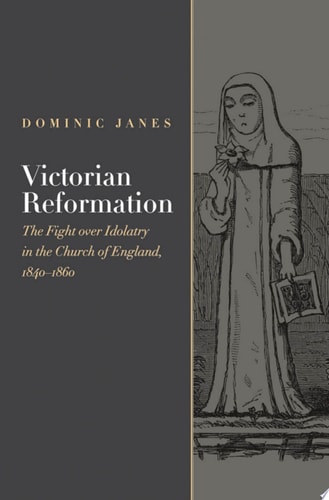
Victorian Reformation: The Fight Over Idolatry in the Church of England, 1840-1860
0
0
As an Amazon Associate and affiliate partner, Menrva Books earns from qualifying purchases. Learn more
Author Description
In early Victorian England there was intense interest in understanding the early Church as an inspiration for contemporary sanctity. This was manifested in a surge in archaeological inquiry and also in the construction of new churches using medieval models. Some Anglicans began to use a much more complicated form of ritual involving vestments, candles, and incense. This "Anglo-Catholic" movement was vehemently opposed by evangelicals and dissenters, who saw this as the vanguard of full-blown "popery." The disputed buildings, objects, and art works were regarded by one side as idolatrous and by the other as sacred and beautiful expressions of devotion. Dominic Janes seeks to understand the fierce passions that were unleashed by the contended practices and artifacts - passions that found expression in litigation, in rowdy demonstrations, and even in physical violence. During this period, Janes observes, the wider culture was preoccupied with the idea of pollution caused by improper sexuality. The Anglo-Catholics had formulated a spiritual ethic that linked goodness and beauty. Their opponents saw this visual worship as dangerously sensual. In effect, this sacred material culture was seen as a sexual fetish. The origins of this understanding, Janes shows, lay in radical circles, often in the context of the production of anti-Catholic pornography which titillated with the contemplation of images of licentious priests, nuns, and monks.
Menrva's Summary
THE THESIS
This book investigates how the intense conflict over ritual and material culture in the mid-19th-century Church of England became a proxy for broader anxieties regarding sexuality and social morality. Dominic Janes, a scholar of cultural and religious history, utilizes a wide array of primary sources—including legal records, pamphlets, and visual media—to argue that the opposition to Anglo-Catholic practices was deeply rooted in contemporary perceptions of sensuality and the cultural legacy of anti-Catholic rhetoric. By examining the intersection of theology and material aesthetics, Janes demonstrates how the physical objects of worship were transformed into symbols of moral and sexual danger.
THE SCOPE MAP
What You Will Find
- Analysis of the Anglo-Catholic movement's use of vestments, candles, and incense.
- Examination of the link between religious ritual and Victorian-era sexual anxieties.
- Historical overview of anti-Catholic pornography and its influence on public perception.
- Documentation of public protests, litigation, and physical violence surrounding church architecture.
Scope Limits
- The study is strictly confined to the period between 1840 and 1860 in England.
- The analysis does not focus on the theological nuances of the Oxford Movement beyond their impact on material culture.
THE AUTHORITY PERSPECTIVE
Scholars frequently cite this work for its innovative application of cultural theory to the study of religious history. Experts highlight the text as a significant contribution to understanding how visual and material culture functioned as a battleground for Victorian social identity.
Page Count:
238
Publication Date:
2009-01-01
Publisher:
Oxford University Press
ISBN-10:
0190452218
ISBN-13:
9780190452216
Religion
History
Church History
Cultural History
Ritualism
Art History
Community Tags
Similar Books