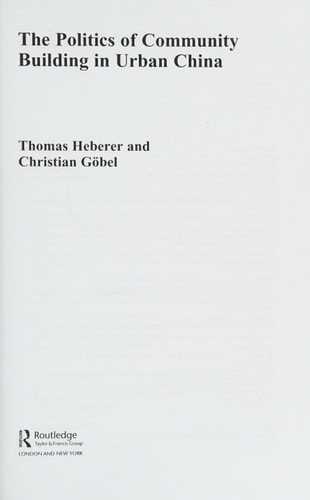
The Politics of Community Building in Urban China
0
0
As an Amazon Associate and affiliate partner, Menrva Books earns from qualifying purchases. Learn more
Author Description
This Book Aims To Make Sense Of The Recent Reform Of Neighbourhood Institutions In Urban China. It Builds On The Observation That The Late 1990s Saw A Comeback Of The State In Urban China After The Increased Economization Of Life In The 1980s Had Initially Forced It To Withdraw. Based On Several Months Of Fieldwork In Locations Ranging From Poor And Dilapidated Neighbourhoods In Shenyang City To Middle Class Gated Communities In Shenzhen, The Authors Analyze Recent Attempts By The Central Government To Enhance Stability In China’s Increasingly Volatile Cities. In Particular, They Argue That The Central Government Has Begun To Restructure Urban Neighbourhoods, And Has Encouraged Residents To Govern Themselves By Means Of Democratic Procedures. Heberer And Göbel Also Contend That Whilst On The One Hand, The Central Government Has Managed To Bring The Party-state Back Into Urban Society, Especially By Tapping Into A Range Of Social Groups That Depend On It, It Has Not, However, Managed To Establish A Broad Base For Participation. In Testing This Hypothesis, The Book Examines The Rationales, Strategies And Impacts Of This Comeback By Systematically Analyzing How The Reorganization Of Neighbourhood Committees Was Actually Conducted And Find That Opportunities For Participation Were Far More Limited Than Initially Promised. The Book Will Be Of Interest To Students And Scholars Of Chinese Studies, Development Studies, Urban Studies And Asian Studies In General.
Menrva's Summary
THE THESIS
This book investigates how the Chinese central government has attempted to restructure urban neighborhood governance and reassert state influence through the promotion of resident self-governance. Thomas Heberer, a scholar specializing in Chinese political development, utilizes extensive fieldwork conducted across diverse urban settings—from impoverished districts in Shenyang to affluent gated communities in Shenzhen—to evaluate these reforms. The author argues that while the state has successfully re-integrated the party-state into urban social structures by leveraging dependent social groups, these initiatives have failed to foster genuine, broad-based democratic participation among residents.
THE SCOPE MAP
What You Will Find
- Comparative analysis of neighborhood governance across diverse urban socioeconomic environments.
- Evaluation of the 'comeback of the state' following the economic liberalization of the 1980s.
- Empirical evidence derived from months of direct fieldwork and site-specific case studies.
- Assessment of the gap between official government rhetoric regarding democratic procedures and the actual implementation of neighborhood committees.
THE AUTHORITY PERSPECTIVE
Experts in Chinese studies recognize this work as a critical examination of the limitations of state-led grassroots reform in contemporary China. Readers frequently note the academic density of the prose and the value of the author's comparative methodology in understanding urban stability strategies.
Page Count:
194
Publication Date:
2011-01-01
Publisher:
Routledge
ISBN-10:
0203828453
ISBN-13:
9780203828458
Art
Science
Asian Studies
Urban Studies
Sociology
Public Policy
Urban policy
Community Tags
Similar Books