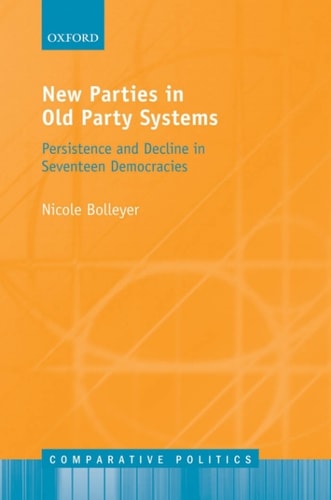
New Parties in Old Party Systems: Persistence and Decline in Seventeen Democracies
0
0
As an Amazon Associate and affiliate partner, Menrva Books earns from qualifying purchases. Learn more
Author Description
New Parties in Old Party Systems addresses a pertinent yet neglected issue in comparative party research: why are some new parties that enter national parliament able to defend a niche on the national level, while other fail to do so? Unlike most existing studies, which strongly focus on electoral (short-term) success or particular party families, this book examines the conditions for the organizational persistence and electoral sustainability of the 140, organizationally new parties that entered their national parliaments in seventeen democracies from 1968 to 2011. The book presents a new theoretical perspective on party institutionalization, which considers the role of both structural and agential factors driving party evolution. It thereby fills some important lacunae in current cross-national research. First, it theorizes the interplay between structural (pre)conditions for party building and the choices of party founders and leaders, whose interplay shapes parties' institutionalization patterns crucial for their evolution, before and after entering national parliament. Second, this approach is substantiated empirically by advanced statistical methods assessing the role of party origin for new party persistence and sustainability. These analyses are combined with a wide range of in-depth case studies capturing how intra-organizational dynamics shape party success and failure. By accounting for new parties' longer-term performance, the study sheds light on the conditions under which the spectacular rise of new parties in advanced democracies is likely to substantively change old party systems. Comparative Politics is a series for students, teachers, and researchers of political science that deals with contemporary government and politics. Global in scope, books in the series are characterised by a stress on comparative analysis and strong methodological rigour. The series is published in association with the European Consortium for Political Research.
Menrva's Summary
THE THESIS
This book investigates the factors that determine whether new political parties successfully persist within established national parliaments or experience rapid decline. Nicole Bolleyer, a scholar in comparative politics, utilizes a dataset of 140 new parties across seventeen democracies from 1968 to 2011 to analyze party institutionalization. She argues that the interplay between structural preconditions and the strategic choices made by party founders and leaders is the primary driver of long-term organizational sustainability.
THE SCOPE MAP
What You Will Find
- A comparative analysis of 140 new parties across seventeen democratic nations.
- A theoretical framework for party institutionalization focusing on structural and agential factors.
- Statistical modeling of party origin and its impact on electoral sustainability.
- In-depth case studies examining intra-organizational dynamics.
Scope Limits
- The study is limited to parties that entered national parliaments between 1968 and 2011.
- It does not focus on parties that failed to achieve initial parliamentary representation.
THE AUTHORITY PERSPECTIVE
Experts in political science recognize this work as a rigorous contribution to the study of party systems and institutional evolution. Readers frequently note the academic density of the prose and the high level of methodological sophistication applied to the comparative data.
Page Count:
272
Publication Date:
2013-01-01
Publisher:
OUP Oxford
ISBN-10:
0191611581
ISBN-13:
9780191611582
Government
Comparative Politics
Sociology
Democracy
Community Tags
Similar Books