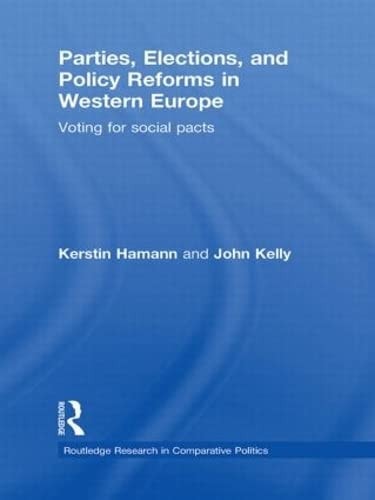
Parties, Elections, and Policy Reforms in Western Europe: Voting for Social Pacts
0
0
As an Amazon Associate and affiliate partner, Menrva Books earns from qualifying purchases. Learn more
Author Description
Social pacts – policy agreements between governments, labor unions and sometimes employer organizations – began to emerge in many countries in the 1980s. The most common explanations for social pacts tend to focus on economic factors, influenced by industrial relations institutions such as highly coordinated collective bargaining. This book presents, and tests, an alternative and complementary explanation highlighting the electoral calculations made by political parties in choosing pacts.Using a dataset covering 16 European countries for the years 1980-2006, as well as eight in-depth country case studies, the authors argue that governments’ choice of social pacts or legislation is less influenced by economic problems, but is strongly influenced by electoral competition. Social pacts will be attractive when party leaders perceive them to be helpful in reducing the potential electoral costs of economic adjustment and wage restraint policies. Alternatively, parties may forgo negotiations with social partners and seek to impose such policies unilaterally if they believe that approach will yield electoral gain or minimize electoral costs.By combining the separate literatures on political economy and party politics, the book sheds new light on the dynamics of social pacts in Western Europe. This book will be of interest to students and scholars of political science, economics, political economy, European Studies and comparative politics.
Menrva's Summary
THE THESIS
This book investigates whether electoral calculations, rather than purely economic pressures, drive the formation of social pacts between governments, labor unions, and employer organizations. Author Kerstin Hamann, a scholar of comparative politics and political economy, challenges the traditional focus on industrial relations institutions. By analyzing data from 16 European countries between 1980 and 2006, the work argues that political parties utilize social pacts as strategic tools to mitigate the electoral risks associated with unpopular economic reforms.
THE SCOPE MAP
What You Will Find
- A comprehensive dataset covering 16 European nations over a 26-year period from 1980 to 2006.
- Eight detailed country case studies providing qualitative depth to the quantitative findings.
- A theoretical framework that integrates political economy with party politics to explain policy-making choices.
- Analysis of the trade-offs between negotiated social pacts and unilateral legislative action in the context of electoral competition.
THE AUTHORITY PERSPECTIVE
Scholars in the field of European politics view this work as a significant contribution to the literature on policy-making and party strategy. Readers frequently note the academic density of the prose and the rigorous methodology applied to the study of labor-government relations.
Page Count:
226
Publication Date:
2010-01-01
Publisher:
Routledge
ISBN-10:
0203848659
ISBN-13:
9780203848654
Economics
Comparative Politics
Elections
Community Tags
Similar Books