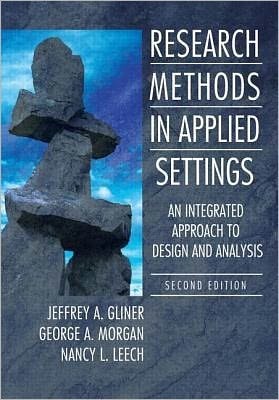
Research Methods in Applied Settings: An Integrated Approach to Design and Analysis
0
0
As an Amazon Associate and affiliate partner, Menrva Books earns from qualifying purchases. Learn more
Author Description
Through its integrated approach to quantitative research methods, this text teaches readers how to plan, conduct, and write a research project and select and interpret data so they can become better consumers of research. This is not a statistics book-there are very few formulas. Rather, this book helps students master which statistic to use when and how to interpret the results. Organized around the steps one takes in conducting a research project, this book is ideal for applied programs and for those who want to analyze and evaluate research articles. Having taught in a variety of departments, the authors have a good grasp of the research problems faced by master's and doctoral students in diverse areas of the behavioral and social sciences. Text adopters applaud the book's clarity. Students are often confused by other texts' use of inconsistent terminology. To avoid this confusion, the authors present a semantically consistent picture that emphasizes five research approaches-- randomized experimental, quasi-experimental, comparative, associational, and descriptive. The authors then show how these approaches lead to three kinds of research designs which, in turn, lead to three groups of statistics with the same names. This consistent framework increases comprehension and the ability to apply the material. Numerous applied problems, annotated examples, and diagrams and tables further promote comprehension. Although the book emphasizes quantitative research, the value of qualitative research is introduced. This extensively revised edition features more than 50% new material including: A new chapter on the evidence-based approach that emphasizes the importance of reporting confidence intervals and effect sizes and the increased use of meta-analysis. An increased emphasis on evaluating research including an 8 step plan for evaluating research validity (Chs. 23 & 24) and its application to the 5 sample studies used throughout the book (Ch. 25). Lots of practical advice
Menrva's Summary
THE THESIS
This text investigates how to effectively design, conduct, and interpret quantitative research within applied behavioral and social science settings. The authors, Jeffrey A. Gliner, George A. Morgan, and Nancy L. Leech, leverage their extensive experience in graduate-level instruction to provide a framework that prioritizes conceptual understanding over complex mathematical formulas. By establishing a semantically consistent terminology across five primary research approaches, the authors enable students to navigate the research process from initial design to final data analysis.
THE SCOPE MAP
What You Will Find
- A structured five-part research framework covering randomized experimental, quasi-experimental, comparative, associational, and descriptive approaches.
- An eight-step methodology for evaluating research validity and interpreting statistical results.
- Practical guidance on reporting confidence intervals, effect sizes, and meta-analysis within an evidence-based context.
- Annotated examples, diagrams, and tables designed to bridge the gap between theoretical design and practical application.
THE AUTHORITY PERSPECTIVE
Academic adopters frequently highlight the text's semantic consistency as a primary advantage for graduate students struggling with conflicting terminology in other manuals. Experts note that the book serves as a highly accessible resource for those who need to evaluate research literature without becoming bogged down in advanced statistical derivation.
Page Count:
488
Publication Date:
2011-01-01
Publisher:
Taylor & Francis Group
ISBN-10:
020384310X
ISBN-13:
9780203843109
Statistics
Research Methods
Alternative Educational Methods
Education
Community Tags
Similar Books













Reader Comments
Share Your Thoughts
No comments yet. Be the first to share your thoughts!