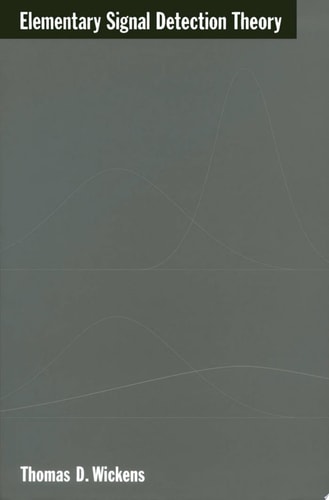
Elementary Signal Detection Theory
0
0
As an Amazon Associate and affiliate partner, Menrva Books earns from qualifying purchases. Learn more
Author Description
Signal detection theory, as developed in electrical engineering and based on statistical decision theory, was first applied to human sensory discrimination about 40 years ago. The theory's intent was to explain how humans discriminate and how we might use reliable measures to quantify this ability. An interesting finding of this work is that decisions are involved even in the simplest of discrimination tasks--say, determining whether or not a sound has been heard (a yes-no decision). Detection theory has been applied to a host of varied problems (for example, measuring the accuracy of diagnostic systems, survey research, reliability of lie detection tests) and extends far beyond the detection of signals. This book is a primer on signal detection theory, useful for both undergraduates and graduate students.
Menrva's Summary
THE THESIS
This text investigates the application of signal detection theory to human sensory discrimination and decision-making processes. Thomas D. Wickens, a researcher in cognitive psychology, utilizes statistical decision theory to provide a foundational framework for understanding how humans quantify sensory accuracy. The book argues that even basic discrimination tasks involve complex decision-making mechanisms that can be measured through rigorous mathematical models.
THE SCOPE MAP
What You Will Find
- Mathematical foundations of signal detection theory
- Applications in diagnostic systems and survey research
- Analysis of yes-no discrimination tasks
- Statistical methodologies for quantifying sensory ability
Scope Limits
- Advanced engineering-specific signal processing applications
- Historical evolution of the theory beyond its psychological utility
THE AUTHORITY PERSPECTIVE
Experts and academics frequently cite this work as a foundational primer for students entering the fields of psychology and sensory science. Readers often note the clarity of the prose, which makes complex statistical concepts accessible to both undergraduate and graduate learners.
Page Count:
262
Publication Date:
2001-01-01
Publisher:
Oxford University Press
ISBN-10:
019028241X
ISBN-13:
9780190282417
Psychology
Research Methods
Mathematics Statistics
Electrical Engineering
Electronics engineering
Professional Career & Trade
Engineering
Probability
Statistics
Signal Theory Telecommunication
Community Tags
Other Editions(3)
Similar Books