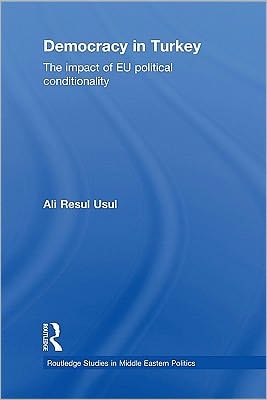
Democracy in Turkey: the impact of EU political conditionality
0
0
As an Amazon Associate and affiliate partner, Menrva Books earns from qualifying purchases. Learn more
Author Description
This book examines the impact of European political conditionality on the process of democratization in Turkey over a twenty year period. Employing theoretical and conceptual approaches to the issue of EU conditionality, the author compares the case of Turkey to that of other European nations.Arguing that Turkey became vulnerable to the European conditionality when it applied for membership in 1987, he shows how the political reforms demanded of Turkey were not fully carried out as the EU had not in essence accepted Turkey as an official candidate during this period. The EU has started to exert real ‘active leverage’ since Turkey was declared an official candidate in 1999, and the author explores how these conditions have exerted a positive influence on democratic consolidation in Turkey. However, its effectiveness in this regard has diminished to a significant extent due to a number of problems that have continued to remain central in EU-Turkey relations.This comprehensive analysis of Turkey-EU political relations and democratization places the case of Turkey within an international context. As such, it will be of interest not only to those studying Turkish politics, government and democracy, but anyone working in the area of international relations and the EU.
Menrva's Summary
THE THESIS
This book investigates the extent to which European Union political conditionality has influenced the democratization process in Turkey over a twenty-year period. Ali Resul Usul utilizes theoretical frameworks regarding international political conditionality to evaluate Turkey's democratic trajectory. By comparing Turkey's experience with that of other European nations, the author argues that the effectiveness of EU leverage is contingent upon the formal status of candidacy and the consistency of political demands. The analysis highlights the shift from passive influence to active leverage following Turkey's official candidacy in 1999.
THE SCOPE MAP
What You Will Find
- A longitudinal analysis of EU-Turkey political relations spanning two decades.
- Comparative case studies contrasting Turkey with other European nations.
- Theoretical frameworks for assessing international political conditionality.
- An evaluation of the impact of official candidacy status on domestic democratic consolidation.
THE AUTHORITY PERSPECTIVE
Experts identify this work as a significant contribution to the study of Turkish politics and international relations. Readers frequently note the academic rigor and the clear, structured approach the author takes in examining the complexities of EU conditionality.
Page Count:
248
Publication Date:
2010-01-01
Publisher:
Routledge
ISBN-10:
0203847385
ISBN-13:
9780203847381
Government
International relations
European Union
Democracy
Turkey