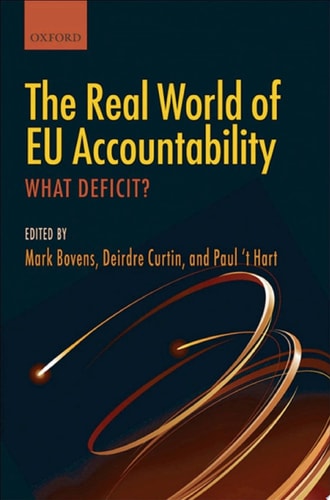
The Real World of EU Accountability: What Deficit?
0
0
As an Amazon Associate and affiliate partner, Menrva Books earns from qualifying purchases. Learn more
Author Description
The Real World of EU Accountability reports the findings of a major empirical study into patterns and practices of accountability in European governance. The product of a 4-year, path-breaking project, this book assesses to what extent and how the people that populate the key arenas where European public policy is made or implemented are held accountable. Using a systematic analytical framework, it examines not just the formal accountability arrangements but also documents and compares how these operate in practice. In doing so, it provides a unique, empirically grounded contribution to the pivotal but often remarkably fact-free debate about democracy and accountability in European governance. With four empirical chapters covering the Commission and its agencies, the European Council, and Comitology committees, it shows that a web of formal accountability arrangements has been woven around most of them, but that the extent to which the relevant accountability forums actually use the oversight possibilities offered to them varies markedly: some forums lack the institutional resources, others the willingness. But in those cases where both are on the increase, as in the European Parliament's efforts vis a vis the European Commission, fundamentally healthy accountability relationships are developing. Although ex-post accountability is only part of the larger equation determining the democratic quality of European governance, this study suggests that at least in this area, the EU is slowly but surely reducing its 'democratic deficit'.
Menrva's Summary
THE THESIS
This book investigates the extent to which European governance institutions are held accountable in practice, challenging the prevailing narrative of a persistent democratic deficit. The authors, Deirdre Curtin, Mark Bovens, and Paul 't Hart, utilize a four-year empirical study to analyze the gap between formal accountability arrangements and their actual implementation. By applying a systematic analytical framework, they evaluate whether the oversight mechanisms within European public policy arenas function effectively or remain largely symbolic.
THE SCOPE MAP
What You Will Find
- Empirical analysis of the European Commission and its agencies
- Comparative study of the European Council and Comitology committees
- A structured framework for evaluating institutional oversight
- Assessment of resource allocation and political willingness in accountability forums
Scope Limits
- Does not provide a comprehensive theory of all democratic legitimacy in the EU
- Focuses primarily on ex-post accountability mechanisms rather than broader legislative or electoral processes
THE AUTHORITY PERSPECTIVE
Experts recognize this work as a significant empirical contribution to the study of EU institutional behavior. Readers frequently note the academic density of the prose and the value of the authors' systematic approach to evaluating governance structures.
Page Count:
256
Publication Date:
2010-01-01
Publisher:
OUP Oxford
ISBN-10:
0191615285
ISBN-13:
9780191615283
English & College Success
English
Professional Career & Trade
Governance
Democracy
European Union
International relations
Public Policy
Linguistics
Public Administration
Comparative Politics
Community Tags
Similar Books