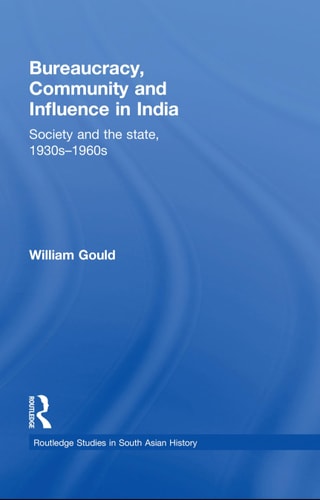
Bureaucracy, Community, and Influence in India: Society and the State, 1930s-1960s
0
0
As an Amazon Associate and affiliate partner, Menrva Books earns from qualifying purchases. Learn more
Author Description
Administrative Power And Public Morality: Hierarchy And Corruption In Late Colonial And Early Independent Up -- Religion, Caste, And Government Servant Recruitment, 1920s-1950s -- Imagining Corruption: Languages And Symbolism In Administrative And Police Power In North India -- The Rise Of Anti-corruption: Government Servants And 'citizens', 1940-1952 -- The Bureaucracy, Police, And Political Change: Maintaining The 'steel Frame' In The 1950s And 1960s. William Gould. Includes Bibliographical References (p. [203]-212) And Index.
Menrva's Summary
THE THESIS
This work investigates the complex interplay between administrative structures, social hierarchies, and the evolving concept of public morality in North India during the transition from colonial rule to independence. William Gould, a scholar of modern South Asian history, utilizes archival records, government reports, and local administrative data to argue that the 'steel frame' of the bureaucracy was not merely a colonial relic but a dynamic entity that adapted to, and was shaped by, the shifting social landscapes of caste, religion, and political citizenship between the 1930s and 1960s.
THE SCOPE MAP
What You Will Find
- Analysis of government servant recruitment patterns regarding caste and religious identity.
- Examination of the linguistic and symbolic construction of corruption in administrative discourse.
- Historical assessment of the police and civil service roles during political transitions.
- Case studies on the emergence of anti-corruption movements and their impact on state-citizen relations.
THE AUTHORITY PERSPECTIVE
Scholars of South Asian history recognize this text as a rigorous examination of the continuity and transformation of state power in post-colonial India. Readers frequently note the academic density of the prose, which provides a detailed look at the mechanics of bureaucracy during a pivotal era of nation-building.
Page Count:
0
Publication Date:
2010-01-01
Publisher:
Routledge
ISBN-10:
0203845382
ISBN-13:
9780203845387
History
Sociology
Corruption
Bureaucracy
Public Administration
India
Community Tags
Similar Books