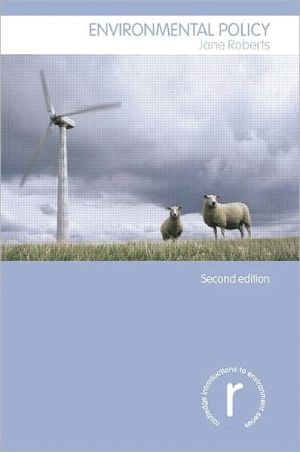
Environmental Policy
0
0
As an Amazon Associate and affiliate partner, Menrva Books earns from qualifying purchases. Learn more
Author Description
Evidence of climate change, resource shortages and biodiversity loss is growing in significance year by year. This second edition of Environmental Policy explains how policy can respond and bring about greater sustainability in individual lifestyles, corporate strategies, national policies and international relations. The book discusses the interaction between environmental and human systems, proposing environmental policy as a way to steer human systems to function within environmental constraints.The second edition has been completely updated to reflect advances in scholarship (for example developments in governance theory) and the increasing primacy of climate policy within environmental policy as a whole. Key political, social and economic concepts are used to explain how effective environmental policies can be designed, implemented and evaluated. Environmental problems, the role of human beings in creating them and sustainable development are all introduced. Environmental policy formulation, implementation and evaluation are discussed within three specific contexts: the firm, the nation state and at an international level. The book reviews the relationship of economics, science and technology to environmental policy. It ends by reflecting upon the predicament of humankind in the twenty-first century and the potential of achieve sustainability through the use of the environmental policy ‘toolbox’.Environmental Policy is an accessible text with a multi-disciplinary perspective. Lively case studies drawn from a range of international examples – and completely updated for this second edition – illustrate issues such as climate change, international trade, tourism and human rights. It includes chapter summaries, suggestions for further reading and links to relevant web resources.
Menrva's Summary
THE THESIS
This book investigates how environmental policy can be structured to effectively steer human systems toward sustainability within the physical constraints of the planet. Jane Roberts provides a comprehensive framework for understanding the intersection of human activity and ecological health, drawing on governance theory and political science to argue that policy is the primary mechanism for managing resource shortages and biodiversity loss. The text synthesizes economic, scientific, and technological perspectives to offer a practical approach for designing and evaluating interventions at the corporate, national, and international levels.
THE SCOPE MAP
What You Will Find
- Analysis of environmental policy formulation, implementation, and evaluation across three distinct scales: the firm, the nation state, and the international arena.
- Integration of key political, social, and economic concepts used to address climate change, resource management, and sustainable development.
- A collection of updated international case studies covering diverse topics such as tourism, international trade, and human rights.
- A pedagogical toolkit including chapter summaries, suggestions for further reading, and curated web resources for ongoing research.
THE AUTHORITY PERSPECTIVE
Experts and students frequently identify this text as a foundational, multi-disciplinary resource for understanding the complexities of environmental governance. Readers often note the clarity of the prose, which makes dense policy concepts accessible while maintaining a rigorous academic standard.
Page Count:
272
Publication Date:
2010-01-01
Publisher:
Routledge
ISBN-10:
0203842839
ISBN-13:
9780203842836
Nature
Economics
Business
Science
Science - Chemistry
Environnement
Nonfiction
Environmental
Sustainability
Public Policy
Community Tags
Other Editions(12)





Similar Books



Reader Comments
Share Your Thoughts
No comments yet. Be the first to share your thoughts!