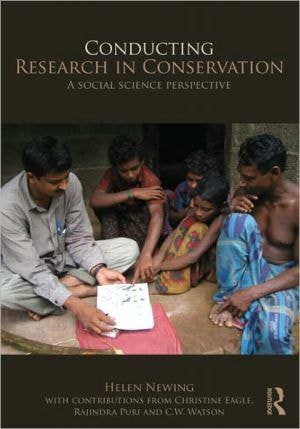
Conducting Research In Conservation: Social Science Methods And Practice
0
0
As an Amazon Associate and affiliate partner, Menrva Books earns from qualifying purchases. Learn more
Author Description
Conducting Research in Conservation is the first textbook on social science research methods written specifically for use in the expanding and increasingly multidisciplinary field of environmental conservation.The first section on planning a research project includes chapters on the need for social science research in conservation, defining a research topic, methodology, and sampling. Section two focuses on practical issues in carrying out fieldwork with local communities, from fieldwork preparation and data collection to the relationships between the researcher and the study community. Section three provides an in-depth focus on a range of social science methods including standard qualitative and quantitative methods such as participant observation, interviewing and questionnaires, and more advanced methods, such as ethnobiological methods for documenting local environmental knowledge and change, and participatory methods such as the ‘PRA’ toolbox. Section four then demonstrates how to analyze social science data qualitatively and quantitatively; and the final section outlines the writing-up process and what should happen after the end of the formal research project.This book is a comprehensive and accessible guide to social science research methods for students of conservation related subjects and practitioners trained in the natural sciences. It features practical worldwide examples of conservation-related research in different ecosystems such as forests; grasslands; marine and riverine systems; and farmland. Boxes provide definitions of key terms, practical tips, and brief narratives from students and practitioners describe the practical issues that they have faced in the field.
Menrva's Summary
THE THESIS
This text addresses the critical need for integrating social science methodologies into environmental conservation research to better understand the human dimensions of ecological management. Helen Newing, drawing on her extensive experience in the field, provides a structured framework for natural scientists and conservation students to design, execute, and analyze social research. The book argues that effective conservation requires a rigorous approach to human-environment interactions, bridging the gap between biological data and social reality.
THE SCOPE MAP
What You Will Find
- Comprehensive planning strategies for conservation-focused research projects.
- Practical guidance on fieldwork preparation and community engagement protocols.
- Detailed explanations of qualitative and quantitative methods, including participant observation and ethnobiological techniques.
- Analytical frameworks for interpreting social data and communicating findings through formal writing.
THE AUTHORITY PERSPECTIVE
Experts recognize this work as a foundational resource for practitioners transitioning from natural science backgrounds into interdisciplinary conservation research. Readers frequently note the clarity of the prose and the utility of the practical examples provided for diverse ecosystems.
Page Count:
400
Publication Date:
2010-01-01
Publisher:
Routledge
ISBN-10:
0203846451
ISBN-13:
9780203846452
Ecology
Conservation
Research Methods
Fieldwork
Social Science
Community Tags
Other Editions(3)
Similar Books

Reader Comments
Share Your Thoughts
No comments yet. Be the first to share your thoughts!