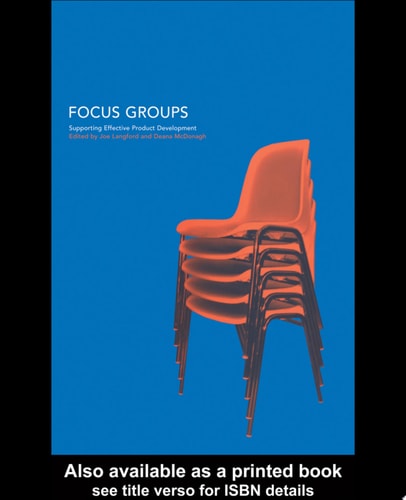
Focus Groups: Supporting Effective Product Development
0
0
As an Amazon Associate and affiliate partner, Menrva Books earns from qualifying purchases. Learn more
Author Description
The focus group is widely used to as a tool for increasing the understanding of users and their requirements, and identifying potential solutions for these requirements. Its main value lies in the conveyance of less tangible information that cannot be obtained using more traditional methods. Eliciting user needs beyond the functional is crucial for effective product and system development. This approach offers one way in which such needs may be elicited. While most texts in product development cater to marketing, political and social science research, this book describes the way focus groups can be applied particularly to ergonomics (human factors) and design-related projects. The book demystifies the subject and includes practical guidance for setting up and running focus group sessions to enable the professional (and novice) to employ these techniques usefully and with confidence. An ideal book for the professional to the undergraduate student, Focus Groups: Supporting Effective Product Development is written for ergonomists, designers and anyone running product related focus groups or involved in product research.
Menrva's Summary
THE THESIS
How can focus groups be effectively utilized to elicit non-functional user needs and improve product development outcomes? Deana McDonagh and Joe Langford provide a specialized framework for applying focus group methodology specifically to the fields of ergonomics and industrial design. By moving beyond traditional marketing-focused research, the authors argue that qualitative insights into user behavior are essential for creating systems that align with human factors. The text serves as a practical manual for integrating these research techniques into the design cycle.
THE SCOPE MAP
What You Will Find
- Methodologies for conducting focus groups within ergonomics and design-related projects
- Practical guidance for planning, facilitating, and analyzing focus group sessions
- Techniques for identifying intangible user requirements beyond basic functional needs
- Frameworks for applying qualitative research to product and system development
THE AUTHORITY PERSPECTIVE
Professionals and students in the design field identify this text as a practical resource for bridging the gap between user research and product engineering. Experts highlight the book's utility in demystifying qualitative research methods for those primarily trained in technical or design-oriented disciplines.
Page Count:
240
Publication Date:
2002-01-01
Publisher:
Taylor & Francis Group
ISBN-10:
0203302745
ISBN-13:
9780203302743
Business
Focus Groups
Research Methods
Product Development
Design
Ergonomics
Community Tags
Similar Books