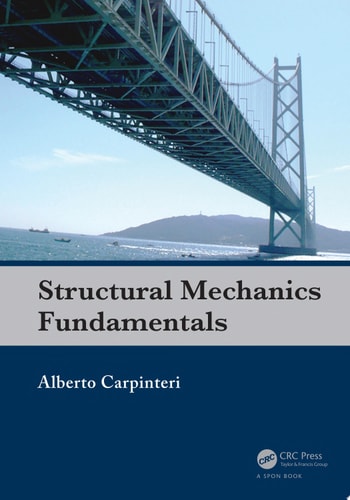
Structural Mechanics Fundamentals
0
0
As an Amazon Associate and affiliate partner, Menrva Books earns from qualifying purchases. Learn more
Author Description
Structural Mechanics Fundamentals gives you a complete and uniform treatment of the most fundamental and essential topics in structural mechanics. Presenting a traditional subject in an updated and modernized way, it merges classical topics with ones that have taken shape in more recent times, such as duality. This book is extensively based on the introductory chapters to the author’s Structural Mechanics: A Unified Approach. Coverage includes: The basic topics of geometry of areas and of kinematics and statics of rigid body systems The mechanics of linear elastic solids—beams, plates, and three-dimensional solids—examined using a matrix approach The analysis of strain and stress around a material point The linear elastic constitutive law, with related Clapeyron’s and Betti’s theorems Kinematic, static, and constitutive equations The implication of the principle of virtual work The Saint Venant problem The theory of beam systems—statically determinate or indeterminate Methods of forces and energy for the examination of indeterminate beam systems The book draws on the author’s many years of teaching experience and features a wealth of illustrations and worked examples to help explain the topics clearly yet rigorously. The book can be used as a text for senior undergraduate or graduate students in structural engineering or architecture and as a valuable reference for researchers and practicing engineers.
Menrva's Summary
THE THESIS
This text investigates the core principles of structural mechanics by synthesizing classical theory with modern analytical frameworks. Alberto Carpinteri, a seasoned educator in the field, utilizes his extensive teaching background to present a unified approach to the subject. The book bridges the gap between foundational rigid body statics and advanced matrix-based analysis of elastic solids, providing a rigorous mathematical basis for structural engineering students and professionals.
THE SCOPE MAP
What You Will Find
- Comprehensive coverage of geometry of areas, kinematics, and statics of rigid body systems.
- Matrix-based methodology for analyzing beams, plates, and three-dimensional elastic solids.
- Detailed examination of strain, stress, and linear elastic constitutive laws including Clapeyron’s and Betti’s theorems.
- Practical application of the principle of virtual work and the Saint Venant problem for indeterminate beam systems.
THE AUTHORITY PERSPECTIVE
Experts and educators recognize this work as a robust pedagogical resource for senior undergraduate and graduate-level engineering curricula. Readers frequently note the technical density of the prose, which serves as a reliable reference for both academic study and professional practice.
Page Count:
512
Publication Date:
2013-01-01
Publisher:
CRC Press
ISBN-10:
0203851137
ISBN-13:
9780203851135
Architecture
Structural
Physics
Structural Mechanics
textbook
Trades & Technology
Engineering
Community Tags
Other Editions(5)

Similar Books








Reader Comments
Share Your Thoughts
No comments yet. Be the first to share your thoughts!