The Double Game
0
0
As an Amazon Associate and affiliate partner, Menrva Books earns from qualifying purchases. Learn more
Author Description
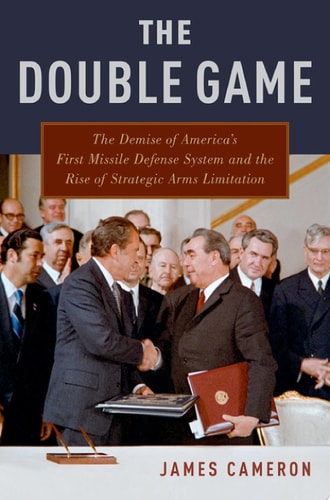
How did the United States move from a position of nuclear superiority over the Soviet Union at the beginning of the 1960s to one of nuclear parity under the doctrine of mutual assured destruction in 1972? Drawing on declassified records of conversations three presidents had with their most trusted advisors, James Cameron offers an original answer to this question. John F. Kennedy, Lyndon Johnson, and Richard Nixon struggled to reconcile their personal convictions about the nuclear arms race with the views of the public and Congress. In doing so they engaged in a double game, hiding their true beliefs behind a façade of strategic language while grappling in private with the complex realities of the nuclear age. Cameron shows how, despite reservations about the nuclear buildup, Kennedy and Johnson pushed ahead with an anti-ballistic missile (ABM) system for the United States, fearing the domestic political consequences of scrapping both the system and the popular doctrine of strategic superiority that underpinned it. By contrast, the abrupt decline in US public and congressional support in 1969 forced Nixon to give up America's first ABM and the US lead in offensive ballistic missiles through agreements with the Soviet Union, despite his conviction that the US needed a nuclear edge to maintain the security of the West. By placing this dynamic at the center of the story, The Double Game provides a new overarching interpretation of this pivotal period in the development of US nuclear policy and a window onto current debates over nuclear superiority, deterrence, and the future of American grand strategy.
Menrva's Summary
THE THESIS
This book investigates how the United States transitioned from a position of nuclear superiority to one of parity with the Soviet Union between 1960 and 1972. James N. Cameron, a scholar of international history, utilizes newly declassified records of presidential deliberations to analyze the internal conflicts of three administrations. He argues that Kennedy, Johnson, and Nixon maintained a 'double game,' publicly advocating for strategic superiority while privately grappling with the political and military realities of the nuclear age.
THE SCOPE MAP
What You Will Find
- Analysis of US nuclear policy from 1960 to 1972.
- Examination of the political pressures surrounding the anti-ballistic missile (ABM) system.
- Comparative study of the Kennedy, Johnson, and Nixon administrations.
Scope Limits
- The text does not cover post-1972 nuclear developments or the later stages of the Cold War.
- It focuses primarily on the intersection of domestic politics and executive decision-making rather than technical military specifications.
THE AUTHORITY PERSPECTIVE
Experts recognize this work as a significant contribution to the study of Cold War diplomacy and executive decision-making. Readers frequently note the clarity with which the author synthesizes complex declassified records into a coherent narrative of political strategy.
Page Count:
320
Publication Date:
2017-01-01
Publisher:
Oxford University Press
ISBN-10:
019045993X
ISBN-13:
9780190459932
History
American History
Cold War
Nuclear Strategy
International relations