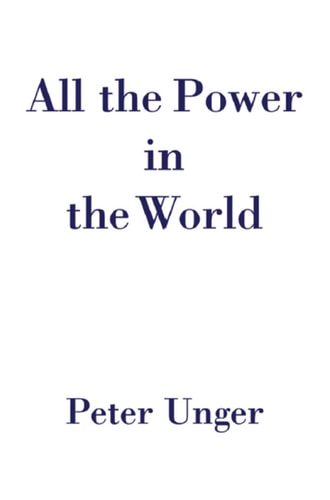
All the Power in the World
0
0
As an Amazon Associate and affiliate partner, Menrva Books earns from qualifying purchases. Learn more
Author Description
This bold and original work of philosophy presents an exciting new picture of concrete reality. Peter Unger provocatively breaks with what he terms the conservatism of present-day philosophy, and returns to central themes from Descartes, Locke, Berkeley, Hume and Russell. Wiping the slate clean, Unger works, from the ground up, to formulate a new metaphysic capable of accommodating our distinctly human perspective. He proposes a world with inherently powerful particulars of two basic sorts: one mental but not physical, the other physical but not mental. Whether of one sort or the other, each individual possesses powers for determining his or her own course, as well as powers for interaction with other individuals. It is only a purely mental particular--an immaterial soul, like yourself--that is ever fit for real choosing, or for conscious experiencing. Rigorously reasoning that the only satisfactory metaphysic is one that situates the physical alongside the non-physical, Unger carefully explains the genesis of, and continual interaction of, the two sides of our deeply dualistic world. Written in an accessible and entertaining style, while advancing philosophical scholarship, All the Power in the World takes readers on a philosophical journey into the nature of reality. In this riveting intellectual adventure, Unger reveals the need for an entirely novel approach to the nature of physical reality--and shows how this approach can lead to wholly unexpected possibilities, including disembodied human existence for billions of years. All the Power in the World returns philosophy to its most ambitious roots in its fearless attempt to answer profoundly difficult human questions about ourselves and our world.
Menrva's Summary
THE THESIS
Can a new metaphysical framework reconcile the existence of physical reality with the distinctly human experience of consciousness and agency? Peter Unger, a prominent philosopher, challenges contemporary philosophical conservatism by revisiting foundational inquiries from thinkers like Descartes, Locke, and Hume. He constructs a dualistic model that posits two distinct types of particulars—mental and physical—to explain the nature of reality and the potential for conscious existence beyond the physical body.
THE SCOPE MAP
What You Will Find
- A dualistic metaphysical framework distinguishing between mental and physical particulars.
- Arguments regarding the nature of agency and conscious experience.
- Philosophical analysis of disembodied existence and the interaction between mind and matter.
Scope Limits
- The text does not provide empirical scientific evidence for the existence of immaterial souls.
- It does not address theological or religious implications of the proposed dualism.
THE AUTHORITY PERSPECTIVE
Scholars and readers often note the ambitious scope of Unger's project, which seeks to revive classical metaphysical inquiry within a modern analytical context. Experts frequently highlight the accessibility of the prose, though they acknowledge that the book's radical conclusions regarding dualism remain a subject of intense debate within the field.
Page Count:
668
Publication Date:
2007-01-01
Publisher:
Oxford University Press
ISBN-10:
0190450789
ISBN-13:
9780190450786
Non-Fiction
Philosophy
Physics
Consciousness
Reality
Metaphysics
Dualism
Community Tags
Other Editions(3)
Similar Books


Reader Comments
Share Your Thoughts
No comments yet. Be the first to share your thoughts!