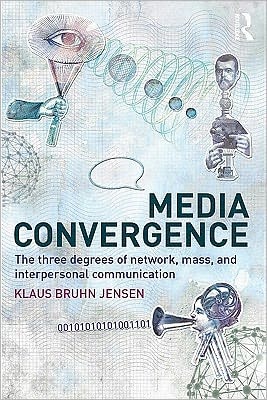
Media Convergence: The Three Degrees of Network, Mass and Interpersonal Communication
0
0
As an Amazon Associate and affiliate partner, Menrva Books earns from qualifying purchases. Learn more
Author Description
The development of digital media presents a unique opportunity to reconsider what communication is, and what individuals, groups, and societies might hope to accomplish through new as well as old media. At a time when digital media still provoke both utopian and dystopian views of their likely consequences, Klaus Bruhn Jensen places these 'new' media in a comparative perspective together with 'old' mass media and face-to-face communication, restating the two classic questions of media studies: what do media do to people, and what do people do with media? Media Convergence makes a distinction between three general types of media: the human body enabling communication in the flesh; the technically reproduced means of mass communication; and the digital technologies facilitating interaction one-to-one, one-to-many, as well as many-to-many. Features include: case studies, including mobile phones in everyday life, the Muhammad cartoons controversy and climate change as a global challenge for human communication and political action diagrams, figures, and tables summarizing key concepts beyond standard 'models of communication' systematic cross-referencing. Major terms are highlighted and cross-referenced throughout, with key concepts defined in margin notes.
Menrva's Summary
THE THESIS
How do digital technologies fundamentally alter the established dynamics between interpersonal, mass, and network communication? Klaus Bruhn Jensen, a prominent scholar in media and communication studies, utilizes a comparative framework to analyze the evolution of media from face-to-face interaction to mass media and contemporary digital networks. He argues that by situating new media alongside traditional forms, we can better address the enduring questions of how media influences human behavior and how individuals actively shape their media environments.
THE SCOPE MAP
What You Will Find
- A tripartite classification of media: interpersonal (the body), mass (technically reproduced), and network (digital interaction).
- Empirical case studies examining mobile phone usage, the Muhammad cartoons controversy, and climate change communication.
- Analytical diagrams and tables that synthesize complex communication models into accessible conceptual frameworks.
- A systematic pedagogical structure featuring highlighted terms and margin notes for key concept definitions.
THE AUTHORITY PERSPECTIVE
Experts recognize this text as a foundational contribution to media theory, particularly for its ability to bridge the gap between historical mass communication and modern digital interaction. Readers frequently note the academic density of the prose, which is balanced by the author's clear, structured approach to defining complex communication phenomena.
Page Count:
198
Publication Date:
2010-02-05
Publisher:
Taylor & Francis Group
ISBN-10:
0203855485
ISBN-13:
9780203855485
Digital Media
Technology
Media Studies
Sociology
Communication
Information Theory