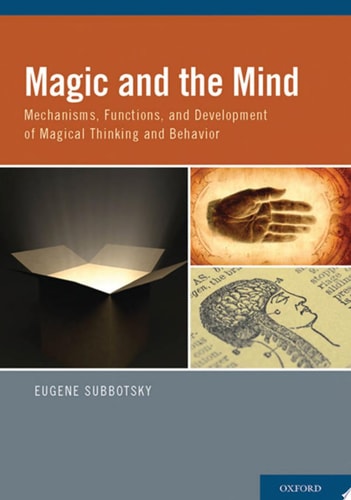
Magic and the Mind: Mechanisms, Functions, and Development of Magical Thinking and Behavior
0
0
As an Amazon Associate and affiliate partner, Menrva Books earns from qualifying purchases. Learn more
Author Description
Magical thinking and behavior have traditionally been viewed as immature, misleading alternatives to scientific thought that in children inevitably diminish with age. In adults, these inclinations have been labeled by psychologists largely as superstitions that feed on frustration, uncertainty, and the unpredictable nature of certain human activities. In Magic and the Mind, Eugene Subbotsky provides an overview of the mechanisms and development of magical thinking and beliefs throughout the life span while arguing that the role of this type of thought in human development should be reconsidered. Rather than an impediment to scientific reasoning or a byproduct of cognitive development, in children magical thinking is an important and necessary complement to these processes, enhancing creativity at problem-solving and reinforcing coping strategies, among other benefits. In adults, magical thinking and beliefs perform important functions both for individuals (coping with unsolvable problems and stressful situations) and for society (enabling mass influence and promoting social harmony). Operating in realms not bound by physical causality, such as emotion, relationships, and suggestion, magical thinking is an ongoing, developing psychological mechanism that, Subbotsky argues, is integral in the contexts of politics, commercial advertising, and psychotherapy, and undergirds our construction and understanding of meaning in both mental and physical worlds. Magic and the Mind represents a unique contribution to our understanding of the importance of magical thinking, offering experimental evidence and conclusions never before collected in one source. It will be of interest to students and scholars of developmental psychology, as well as sociologists, anthropologists, and educators.
Menrva's Summary
THE THESIS
This book investigates the psychological mechanisms and developmental functions of magical thinking, challenging the traditional view that such thought is merely an immature or irrational byproduct of human cognition. Eugene Subbotsky, a researcher in developmental psychology, utilizes experimental data and cross-disciplinary analysis to argue that magical thinking serves as a necessary complement to scientific reasoning. He posits that these cognitive processes are integral to human development, creativity, and social cohesion throughout the entire life span.
THE SCOPE MAP
What You Will Find
- Analysis of magical thinking across childhood and adulthood
- Examination of the role of magical beliefs in coping with stress and unsolvable problems
- Discussion of the influence of magical thinking in politics, advertising, and psychotherapy
- Experimental evidence regarding the persistence of non-causal thought patterns
Scope Limits
- The text does not provide a comprehensive history of occult or supernatural practices
- It does not focus on clinical pathology or the treatment of delusional disorders
THE AUTHORITY PERSPECTIVE
Experts recognize this work as a significant synthesis of experimental evidence regarding non-causal cognitive processes. Readers frequently note the academic density of the prose, which is intended for students and scholars within the social sciences.
Page Count:
216
Publication Date:
2010-01-01
Publisher:
Oxford University Press
ISBN-10:
0190453117
ISBN-13:
9780190453114
Psychology
Behavioral Science
Sociology
Developmental Psychology
Magical thinking
Anthropology
Community Tags
Similar Books