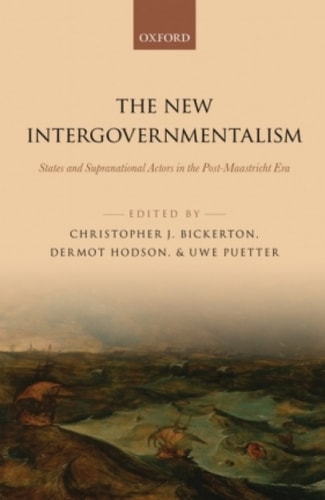
The New Intergovernmentalism: States and Supranational Actors in the Post-Maastricht Era
0
0
As an Amazon Associate and affiliate partner, Menrva Books earns from qualifying purchases. Learn more
Author Description
The twenty years since the signing of the Maastricht Treaty have been marked by an integration paradox: although the scope of European Union (EU) activity has increased at an unprecedented pace, this increase has largely taken place in the absence of significant new transfers of power to supranational institutions along traditional lines. Conventional theories of European integration struggle to explain this paradox because they equate integration with the empowerment of specific supranational institutions under the traditional Community method. New governance scholars, meanwhile, have not filled this intellectual void, preferring instead to focus on specific deviations from the Community method rather than theorizing about the evolving nature of the European project. The New Intergovernmentalism challenges established assumptions about how member states behave, what supranational institutions want, and where the dividing line between high and low politics is located, and develops a new theoretical framework known as the new intergovernmentalism. The fifteen chapters in this volume by leading political scientists, political economists, and legal scholars explore the scope and limits of the new intergovernmentalism as a theory of post-Maastricht integration and draw conclusions about the profound state of political disequilibrium in which the EU operates. This book is of relevance to EU specialists seeking new ways of thinking about European integration and policy-making, and general readers who wish to understand what has happened to the EU in the two troubled decades since 1992.
Menrva's Summary
THE THESIS
This volume investigates the integration paradox of the European Union, questioning why the scope of EU activity has expanded significantly since the Maastricht Treaty without a corresponding transfer of power to supranational institutions. The authors, Christopher J. Bickerton, Dermot Hodson, and Uwe Puetter, along with a team of political scientists and legal scholars, argue that conventional integration theories fail to account for this shift. They propose a new theoretical framework, the 'new intergovernmentalism,' to explain how member states and supranational actors interact in a landscape where traditional power dynamics have fundamentally altered.
THE SCOPE MAP
What You Will Find
- A theoretical framework for understanding post-Maastricht European integration.
- Analysis of the evolving relationship between member states and supranational institutions.
- Fifteen chapters covering political economy, legal structures, and policy-making dynamics.
Scope Limits
- The analysis focuses primarily on the period following the 1992 Maastricht Treaty.
- The text does not provide a comprehensive history of the EU prior to the 1990s.
THE AUTHORITY PERSPECTIVE
Experts in European studies recognize this work as a significant contribution to the debate on EU governance and institutional theory. Readers frequently note the academic density of the prose, which is intended for specialists and students of political science.
Page Count:
368
Publication Date:
2015-01-01
Publisher:
OUP Oxford
ISBN-10:
0191008648
ISBN-13:
9780191008641
History
European
International relations
European Union
Governance
Public Policy
Community Tags
Similar Books