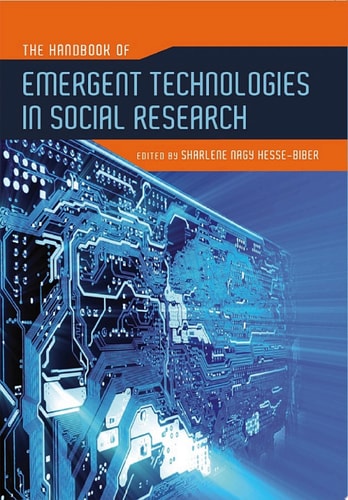
The Handbook of Emergent Technologies in Social Research
0
0
As an Amazon Associate and affiliate partner, Menrva Books earns from qualifying purchases. Learn more
Author Description
Emergent technologies are pushing the boundaries of how both qualitative and quantitative researchers practice their craft, and it has become clear these changes are dramatically altering research design, from the questions researchers ask and the ways they collect data, to what they even consider data.Gathering a broad range of new developments in one place, The Handbook of Emergent Technologies in Social Research offers comprehensive, up-to-date thinking on technological innovations. In addition to addressing how to effectively apply new technologies-such as the internet, mobile technologies, geospatial technologies (GPS), and the incorporation of computer-assisted software programs (CAQDAS) to qualitative, quantitative, and mixed-methods approaches to research projects-many chapters provide in-depth examples of practices within both disciplinary and interdisciplinary environments and outside the academic world in multi-media laboratories and research institutes. Not only an authoritative view of cutting-edge technologies and their applications, the Handbook examines the costs and benefits of utilizing new technologies on the research process, the potential misuse of these techniques for methods practices, and the ethical and moral dimensions of emergent technologies, especially with regard to issues of surveillance and privacy.The Handbook of Emergent Technologies in Social Research is an essential resource for research methods courses in various fields, including the social sciences, education, communications, computer science, and health services, and an indispensable guide for social researchers looking to incorporate emerging technologies into their methods and practice.
Menrva's Summary
THE THESIS
This volume investigates how the integration of emergent digital technologies is fundamentally restructuring the landscape of social research design, data collection, and methodological practice. Sharlene Nagy Hesse-Biber, a prominent scholar in mixed-methods research, compiles contributions from various experts to analyze the intersection of technological innovation and social inquiry. The text argues that researchers must critically evaluate both the functional utility and the ethical implications of adopting new digital tools within their investigative frameworks.
THE SCOPE MAP
What You Will Find
- Applications of internet-based research, mobile technologies, and geospatial tools (GPS).
- Integration strategies for computer-assisted qualitative data analysis software (CAQDAS).
- Ethical frameworks regarding surveillance, privacy, and the potential misuse of digital data.
- Case studies from disciplinary, interdisciplinary, and non-academic research environments.
Scope Limits
- Does not provide exhaustive technical tutorials for specific software packages.
- Does not cover historical research methods prior to the digital age.
THE AUTHORITY PERSPECTIVE
Experts recognize this work as a comprehensive reference for integrating modern digital tools into social science curricula. Readers frequently note the academic density of the prose, which serves as a foundational resource for both graduate students and professional researchers.
Page Count:
720
Publication Date:
2011-01-01
Publisher:
Oxford University Press
ISBN-10:
0190451882
ISBN-13:
9780190451882
Social Science
Professional Career & Trade
Data Analysis
Qualitative Research
Linguistics
Technology
English & College Success
English
Resources for Business Professionals
Social Research
Sociology
Research Methods
Community Tags
Other Editions(3)


Similar Books














Reader Comments
Share Your Thoughts
No comments yet. Be the first to share your thoughts!