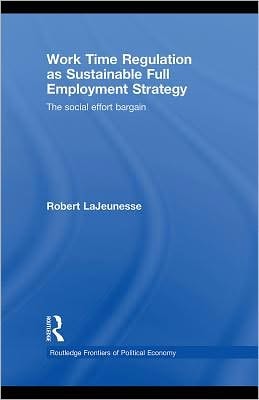
Work Time Regulation As A Sustainable Full Employment Strategy: The Social Effort Bargain
0
0
As an Amazon Associate and affiliate partner, Menrva Books earns from qualifying purchases. Learn more
Author Description
Robert LaJeunesse looks beyond the 20th century arguments for shortening the work week. He writes a careful, convincing critique of traditional full employment policies in advocacy of an alternative macroeconomic paradigm. With an emphasis on greater socioeconomic participation, the author proposes a policy of work time regulation that is not only appropriate for a 21st century post-industrial economy, but speaks to concerns about balancing work and family, environmental sustainability, stabilizing incomes and prices, and social and economic well being.Through its unique conceptualization of employment relations as a social effort bargain, this book proposes that governments can achieve egalitarian and sustainable macroeconomic objectives by regulating work hours. Equally important to achieving sustainable full employment and price stability, work time regulation offers the capability for citizens living in an age of abundance to define themselves as something other than paid employees. Work time reform represents a first step in a process of enlightenment in which workers will create an identity through the whole of their relationships at work, home, community, and at play. There is certainly a role for government in fostering the pursuit of "loftier ideals" subsequent to a redistribution of work time, but the first precondition for enhanced human development is greater socioeconomic participation, which means more paid work for some and less for others.In addition to students and researchers in economics, sociology, and political science, this book will be of interest to policy makers, policy analysts, labour unionists, environmentalists, and other social reformers.
Menrva's Summary
THE THESIS
Can the regulation of work hours serve as a viable macroeconomic strategy to achieve sustainable full employment and social stability in a post-industrial economy? Robert LaJeunesse, an economist, challenges traditional full employment policies by introducing the concept of the social effort bargain. He argues that by redistributing work time, governments can foster greater socioeconomic participation, stabilize prices, and provide citizens with the opportunity to pursue human development beyond their roles as paid employees.
THE SCOPE MAP
What You Will Find
- A critique of 20th-century full employment models and their limitations in the modern era.
- The conceptual framework of the social effort bargain as a tool for economic reform.
- Analysis of the intersection between work time regulation, environmental sustainability, and family well-being.
- Policy recommendations for achieving egalitarian macroeconomic objectives through labor market intervention.
THE AUTHORITY PERSPECTIVE
Experts and researchers in labor economics and sociology identify this text as a significant contribution to the discourse on post-industrial labor reform. Readers frequently note the academic rigor of the author's argument and its utility for policy analysts and social reformers seeking alternatives to conventional employment strategies.
Page Count:
272
Publication Date:
2009-01-01
Publisher:
Routledge
ISBN-10:
0203879538
ISBN-13:
9780203879535
Economics
Sociology
Hours Of Labor
Public Policy
Labor Studies
Community Tags
Similar Books