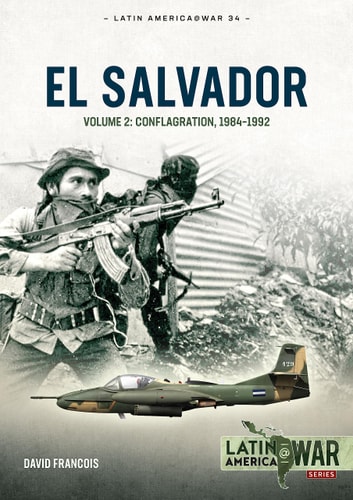
El Salvador Volume 2: Conflagration, 1984-1992
0
0
As an Amazon Associate and affiliate partner, Menrva Books earns from qualifying purchases. Learn more
Author Description
Francois does an excellent job offering an entry-level survey of an extraordinarily brutal civil war that lasted for two decades." -- The Journal of the Air Force Historical Foundation A severe social and political crisis in El Salvador during the 1970s resulted in widespread disturbance of daily life, political violence, repression and the outbreak of an insurgency. In March 1981, the government ran a large sweep operation along the border with Honduras in the north, accompanied by the use of scorched earth tactics and indiscriminate killing of anyone captured. A second offensive, launched in November 1981, was conducted in a similar fashion, and resulted in the massacre of hundreds of civilians by government troops. Under pressure, the insurgency of the Farabundo Marti National Liberation Front (FMLN) called for a peace settlement and the establishment of a government of broad participation. Elections in 1982 were interrupted by a campaign of assassinations by right-wing paramilitaries, which prompted the FMLN to return to arms and hit back with a vicious campaign of attacks on military and economic targets - including Ilopango Air Base, which was heavily hit in February. A new interim government failed to introduce any kind of substantive changes and the armed forces became involved in additional atrocities against human rights activists and union leaders: the result was the next phase of the war that was to last for another two years. In 1984, Christian Democrat José Napoleón Duarte was elected president amid another wave of repression and violence, further reinforced through 1985, despite attempts to reform the armed- and security forces. Nevertheless, by 1986, the notorious 'death squads' were kidnapping and assassinating any opponents they could lay their hands upon. The FMLN thus continued striking back, culminating in the 'final offensive' of 1989, carried out with the aim of unseating a government elected in the obviously fixed elections of
Menrva's Summary
THE THESIS
The book details the brutal civil war in El Salvador from 1984 to 1992, focusing on the escalating violence and political turmoil. It examines the severe social and political crisis that led to widespread disturbance, political violence, and repression, culminating in the outbreak of an insurgency. The narrative covers government offensives employing scorched earth tactics, massacres of civilians, and the Farabundo Marti National Liberation Front's (FMLN) response through attacks on military and economic targets. The text also addresses the challenges faced by elected presidents in implementing reforms amidst ongoing repression and the persistent activities of 'death squads'.
THE SCOPE MAP
- Detailed account of the Salvadoran Civil War (1984-1992).
- Analysis of the social and political crisis leading to the conflict.
- Examination of government military operations, including scorched earth tactics.
- Coverage of the FMLN's insurgency and attacks on military and economic targets.
- Discussion of the role of 'death squads' and human rights abuses.
- Exploration of the political landscape, including presidential elections and reform attempts.
- Review of the period's repression and violence impacting civilians and activists.
THE AUTHORITY PERSPECTIVE
The Journal of the Air Force Historical Foundation commends Francois's work as an excellent entry-level survey of an extraordinarily brutal civil war. The description suggests the book provides a comprehensive overview of the conflict's key events and contributing factors. It appears to cover the period's significant political and military developments, including government actions and insurgent responses. The reception indicates the book is valuable for understanding the complexities of this historical period.
Page Count:
82
Publication Date:
2023-01-01
Publisher:
Helion
ISBN-10:
1804512184
ISBN-13:
9781804512180
History
Non-Fiction
Military History
Community Tags
Similar Books