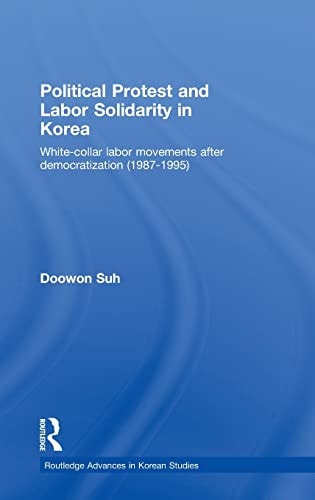
Political Protest and Labour Movements in Korea: Solidarity Among Korean White-Collar Workers
0
0
As an Amazon Associate and affiliate partner, Menrva Books earns from qualifying purchases. Learn more
Author Description
Introduction -- History And Dynamics Of White-collar Unionism In Korea -- Impediments Of Enterprise Unionism -- Theoretical Agenda, Explanatory Framework, And Causal Structure -- Comparison Cases -- Data Sources -- White-collar Unionism As Social Movements -- Definition Of White-collar Labor And Its Trade Union -- White-collar Union Growth And Middle-class Formation In The West -- Cross-societal Variation Of White-collar Unionism In The West -- Labor As Social Movements -- Main Theoretical Perspectives: Structuralism, Voluntarism, And Constructionism -- Integrative And Processual Explanatory Framework -- Theoretical Frameworks For Political Protest And Labor Solidarity -- Collective Action Outcomes -- Political Opportunity -- Organizational Leadership -- Personal Welfare And Economic Justice -- Wage Differential Reduction Demand And Consequences -- National Trend In Wage Structure -- Union Relative Wage Effect Subjective Criteria For Wage Increases: Different Interpretive Frameworks -- Internal Labor Market And Labor Process: Frame Construction -- Workplace Innovation -- Political Protest And Social Reform -- External Criticism And Coalition Strategy -- Intersectoral Variation In Social Reform -- Conditions For Political Protest And Social Reform (1): Perceived Collective Action Outcome Failure -- Conditions For Political Protest And Social Reform (2): Government Repression -- Conditions For Political Protest And Social Reform (3): Leadership Efficacy In Consensus Formation -- Inter-union Solidarity And Industrial Unionism -- Union Density Decline And Financial Crisis -- Coalitional Repertoires: Collaborative Struggle And Multiemployer Bargaining -- Differences In Solidarity Growth -- Conditions For Inter-union Solidarity (1): Perceived Coalition Movement Outcome Success -- Conditions For Inter-union Solidarity (2): Positive Government Response -- Conditions For Inter-union Solidarity (3): Intermediate Leadership Centralization -- Conclusion Doowon Suh. Includes Bib
Menrva's Summary
THE THESIS
This work investigates the structural and social conditions that facilitate political protest and labor solidarity among white-collar workers in South Korea. Author Tu-wŏn Sŏ utilizes a comprehensive sociological framework to analyze the evolution of white-collar unionism, contrasting it with Western models while accounting for the specific political and economic pressures unique to the Korean labor market. By integrating structuralist and constructionist perspectives, the text argues that union growth and coalitional success are contingent upon leadership efficacy, government response, and the perceived outcomes of collective action.
THE SCOPE MAP
What You Will Find
- Historical analysis of white-collar unionism and middle-class formation in Korea.
- Comparative study of labor movements across Western and Korean societal contexts.
- Methodological framework for assessing political opportunity, organizational leadership, and wage structure dynamics.
- Empirical examination of inter-union solidarity, industrial unionism, and the impact of national financial crises on union density.
THE AUTHORITY PERSPECTIVE
Experts recognize this text as a rigorous academic contribution to the study of East Asian labor relations and social movement theory. Readers frequently note the high density of the prose and the systematic, data-driven approach the author employs to explain complex industrial shifts.
Page Count:
240
Publication Date:
2009-01-01
Publisher:
Routledge
ISBN-10:
0203883926
ISBN-13:
9780203883921
Economics
History
Labor Studies
Sociology
White collar workers
Industrial Relations
Labor Movement
Community Tags
Similar Books