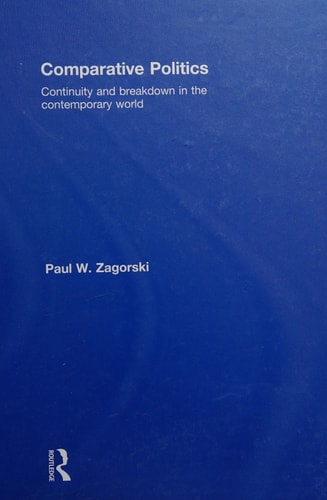
Comparative Politics: Continuity and Breakdown in the Contemporary World
0
0
As an Amazon Associate and affiliate partner, Menrva Books earns from qualifying purchases. Learn more
Author Description
Comparative Politics: Continuity and Breakdown in the Contemporary World is an exciting new core text for introduction to comparative politics courses, focusing on the dynamics of politics: modernization, revolution, coups and democratization. Unlike other texts, Comparative Politics integrates thematic and extensive country-specific material in each chapter, striking a unique balance between discussing a wide range of countries and civilizations in detail, whilst using shorter focused textboxes to clearly illustrate key thematic points. Key features and benefits include: explanations of core concepts such as state, nation, regime, legitimacy, modernization, globalization, revolution, and mass movements an introduction of key theoretical approaches such as institutionalism, structural functionalism, political culture, political economy, and game theory detailed coverage of democratization, advanced democracies, developing countries and communist and post-communist states a range of perspectives to present a nuanced view of the discipline and contemporary political developments case studies of individual countries including Germany, the United States, Russia, Iran, Saudi Arabia, Iraq, Nigeria, Zaire/Congo, South Africa, Brazil, Argentina, Peru, Pakistan, India, Japan, Indonesia, Taiwan, and the People’s Republic of China country-focused textboxes giving a chronology of key developments, including the United Kingdom, France, Afghanistan, and Kosovo. Extensively illustrated throughout with maps, photographs, tables and explanatory boxes, Comparative Politics is an innovative core text, and essential reading for all students of Comparative Politics.
Menrva's Summary
THE THESIS
This text investigates the core dynamics of political systems by analyzing the interplay between continuity and breakdown in contemporary global regimes. Paul W. Zagorski utilizes his academic background to synthesize complex political theories with empirical data, providing a framework that examines how modernization, revolution, and democratization shape state legitimacy. The book argues that understanding political stability requires a dual approach that balances broad theoretical models with specific, localized historical contexts.
THE SCOPE MAP
What You Will Find
- Theoretical frameworks including institutionalism, structural functionalism, political economy, and game theory.
- Comparative analysis of diverse political systems ranging from advanced democracies to post-communist states.
- Detailed case studies of specific nations such as Germany, Brazil, Japan, and Nigeria.
- Chronological data and thematic textboxes illustrating key developments in countries like the United Kingdom and Afghanistan.
THE AUTHORITY PERSPECTIVE
Experts and educators recognize this work as a comprehensive introductory resource that effectively bridges the gap between abstract political theory and practical country-specific application. Students and instructors frequently note the clarity of the thematic textboxes and the breadth of the global case studies provided throughout the volume.
Page Count:
637
Publication Date:
2009-03-23
Publisher:
Routledge
ISBN-10:
0203882474
ISBN-13:
9780203882474
Politics
textbook
Comparative Politics
International relations
Government
Comparative Government
Community Tags
Other Editions(3)


Similar Books




Reader Comments
Share Your Thoughts
No comments yet. Be the first to share your thoughts!