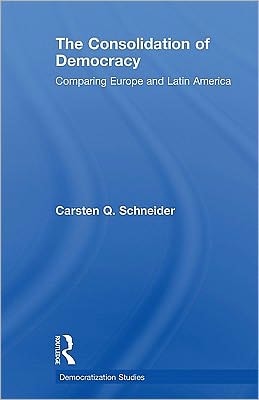
The Consolidation of Democracy: Comparing Europe and Latin America
0
0
As an Amazon Associate and affiliate partner, Menrva Books earns from qualifying purchases. Learn more
Author Description
This Text Seeks To Explain What Factors Account For The Consolidation Of Young Democracies In Over 30 Countries In Latin America And Europe Throughout The Last Quarter Of The 20th Century. Introduction -- Meaning And Measure Of The Consolidation Of Democracy -- The Consolidation Of Democracy Across Time And Space -- Theories Of Cod -- The Fit Of Political Institutions To Societal Contexts -- Casual Complexity And Fuzzy-set Qca -- Cod And The Fit Of Institutions To Contexts -- Choosing Institutions -- Some Notes On How To Study The Impact Of Transition Modes On Cod -- Reframing Debates -- Looking Back And Looking Ahead. Carsten Q. Schneider. Includes Bibliographical References (p. [166]-181) And Index.
Menrva's Summary
THE THESIS
This book investigates the causal factors that facilitate or hinder the consolidation of young democracies across diverse political landscapes. Carsten Q. Schneider utilizes a comparative framework to analyze political transitions in over 30 countries throughout Latin America and Europe during the late 20th century. By examining the interplay between institutional design and societal context, the author seeks to identify the specific conditions under which democratic systems stabilize or fail. The work employs rigorous methodological approaches to move beyond traditional theories of democratic transition.
THE SCOPE MAP
What You Will Find
- A comparative analysis of democratic consolidation across more than 30 nations in Latin America and Europe.
- Application of fuzzy-set Qualitative Comparative Analysis (fsQCA) to evaluate causal complexity.
- An examination of the alignment between political institutions and their respective societal contexts.
- A critical review of existing theories regarding the impact of transition modes on democratic stability.
THE AUTHORITY PERSPECTIVE
Scholars in the field of comparative politics recognize this work as a significant contribution to the study of democratic institutionalization. Readers frequently note the technical rigor of the methodology, making it a valuable resource for students and researchers focused on political development and comparative analysis.
Page Count:
184
Publication Date:
2008-01-01
Publisher:
New York
ISBN-10:
0203886771
ISBN-13:
9780203886779
Comparative Politics
Political Institutions
Comparative Government
Democracy
Community Tags
Similar Books