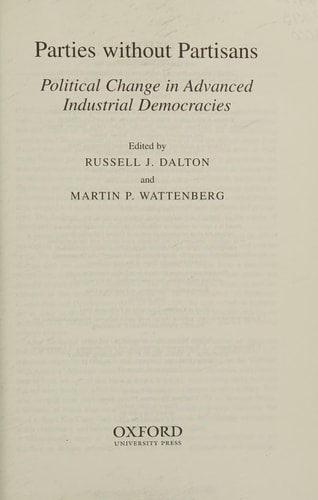
Parties Without Partisans: Political Change in Advanced Industrial Democracies
0
0
As an Amazon Associate and affiliate partner, Menrva Books earns from qualifying purchases. Learn more
Author Description
This book provides the most comprehensive analysis to date of the roles that political parties perform in twenty OECD nations. It finds that parties continue to exercise their traditional roles in organizing elections and structuring the government process, but that they are losing the allegiance of a public that is increasingly non-partisan and sceptical about political parties as institutions. These findings lead to a discussion about the changing nature of representative democracy as these nations enter the 21st Century.
Menrva's Summary
THE THESIS
This book investigates the evolving relationship between political parties and the electorate in advanced industrial democracies, specifically questioning whether parties remain effective vehicles for representation in an era of declining partisan attachment. Authors Martin P. Wattenberg and Russell J. Dalton utilize extensive comparative data from twenty OECD nations to evaluate the functional health of party systems. They argue that while parties maintain their structural utility in government and election management, a significant shift in public sentiment toward non-partisanship threatens the traditional foundations of representative democracy. The text provides a framework for understanding how institutional persistence clashes with changing social attitudes as these nations navigate the 21st century.
THE SCOPE MAP
What You Will Find
- Comparative analysis of political party performance across twenty OECD nations.
- Longitudinal data tracking the decline of partisan identification among voters.
- Examination of the dual role of parties in organizing elections and structuring legislative processes.
- Discussion on the long-term implications of public skepticism for democratic stability.
THE AUTHORITY PERSPECTIVE
Experts frequently cite this work as a foundational text for understanding the erosion of traditional party loyalties in modern democracies. Readers often note the clarity of the comparative methodology, which makes complex political trends accessible to both students and scholars of political science.
Page Count:
328
Publication Date:
2001-04-19
Publisher:
Oxford University Press
ISBN-10:
0199240825
ISBN-13:
9780199240821
Comparative Government
Comparative Politics
Democracy
Sociology
Government
Representative government and representation
Community Tags
Similar Books