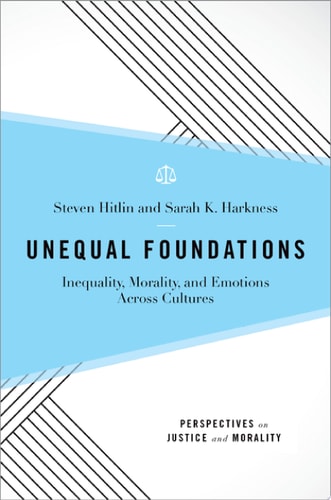
Unequal Foundations: Inequality, Morality, and Emotions across Cultures
0
0
As an Amazon Associate and affiliate partner, Menrva Books earns from qualifying purchases. Learn more
Author Description
Unequal Foundations offers readers a novel theory and a unique use of cross-cultural data to assert that the level of economic inequality in a society is reflected in the emotional experience of its members. People living in societies with more equality (countries such as Japan, Germany, and Canada) generally experience more positive, binding emotions on a regular basis. On the other hand, those living in unequal societies (the United States and China, for example) are significantly more likely to regularly experience negative, sanctioning moral emotions. In this book, authors Steven Hitlin and Sarah K. Harkness explore the idea that morality operates at both the societal and individual levels, and contend that individual moral emotions represent the distal structure of society.In addition to developing this broad theory ranging from society to the individual, Hitlin and Harkness offer their readers a novel use of data from a tool drawn from the affect control theory tradition in order to demonstrate empirical support for this theory. As such, the authors delve deeper than previous literature by presenting data that supports their general approach using a method designed for cross-cultural comparative research.
Menrva's Summary
THE THESIS
This book investigates the relationship between a society's level of economic inequality and the emotional experiences of its individual citizens. Authors Sarah K. Harkness and Steven Hitlin, both established scholars in sociology and social psychology, utilize cross-cultural data to argue that moral emotions serve as a reflection of a nation's structural inequality. They propose that individuals in more egalitarian societies report higher frequencies of positive, binding emotions, whereas those in unequal societies frequently experience negative, sanctioning moral emotions.
THE SCOPE MAP
What You Will Find
- A theoretical framework linking macro-level economic structures to micro-level emotional states
- Comparative analysis of emotional patterns in countries including Japan, Germany, Canada, the United States, and China
- Application of methodologies derived from affect control theory
Scope Limits
- The study does not provide an exhaustive analysis of every global economic system
- The research focuses primarily on the correlation between inequality and emotional experience rather than providing policy solutions for economic reform
THE AUTHORITY PERSPECTIVE
Experts recognize this work as a significant contribution to the intersection of sociology and affective science. Readers frequently note the academic rigor of the methodology and the clarity with which the authors bridge the gap between societal structures and individual psychology.
Page Count:
240
Publication Date:
2017-12-15
Publisher:
Oxford University Press
ISBN-10:
0190465409
ISBN-13:
9780190465407
Economics
Moral Philosophy
Sociology
Community Tags
Similar Books