Faithonomics: Religion and the Free Market
0
0
As an Amazon Associate and affiliate partner, Menrva Books earns from qualifying purchases. Learn more
Author Description
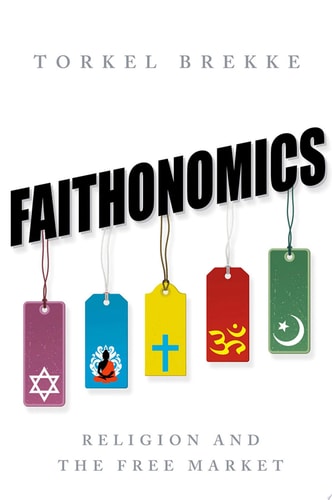
Faithonomics uses economic theory to provide a new and unorthodox view of religion in today's world. Drawing on state-of-the-art research and on case studies from around the globe, this book shows that religion should be analysed as a market similar to markets for other goods and services, like bottled water or haircuts.Faithonomics is about today's religious markets, but in sweeping detours through the histories of Christianity, Islam, Buddhism and Hinduism, Brekke shows us the religious markets of the past, although these were sometimes heavily regulated by states. He argues that government 'control' over religious markets is often the cause of unforeseen and negative consequences. Many of today's problems related to religion, like religious terrorism or rent-seeking by religious political parties, are easier to understand if we think like economists. Religious markets work best when they are relatively free. Religious organizations should be free to sell their products without unnecessary restrictions, but we have no good reason to grant them privileges in the form of subsidies or tax-breaks.
Menrva's Summary
THE THESIS
Can religious institutions and behaviors be effectively analyzed through the lens of economic theory and market dynamics? Torkel Brekke, a scholar of religious history, utilizes economic principles to argue that religious organizations function similarly to providers of goods and services in a competitive marketplace. By examining historical and contemporary data, he posits that government intervention in these markets often produces counterproductive outcomes, suggesting that religious freedom and the absence of state subsidies create more stable and efficient social environments.
THE SCOPE MAP
What You Will Find
- Economic modeling applied to religious organizations and belief systems
- Comparative analysis of Christianity, Islam, Buddhism, and Hinduism
- Examination of rent-seeking behaviors in religious political parties
- Case studies on the impact of state regulation versus market freedom
Scope Limits
- The text does not provide a theological evaluation of religious doctrines
- It does not focus on individual spiritual experiences or personal faith
THE AUTHORITY PERSPECTIVE
Experts note that the book provides a provocative framework for viewing religious institutions as competitive entities rather than purely ideological ones. Readers frequently highlight the clarity of the economic analogies, though some scholars debate the extent to which market theory can fully capture the complexities of religious motivation.
Page Count:
256
Publication Date:
2016-10-15
Publisher:
Oxford University Press
ISBN-10:
0190627697
ISBN-13:
9780190627690
Economics
Non-Fiction
Religion
Sociology
Economics
Community Tags
Similar Books