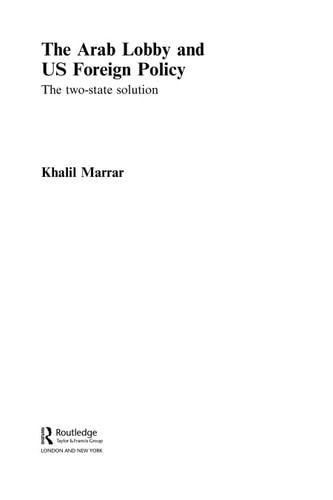
The Arab Lobby and US Foreign Policy: The Two-State Solution
0
0
As an Amazon Associate and affiliate partner, Menrva Books earns from qualifying purchases. Learn more
Author Description
The US foreign policy stance on Israel-Palestine has shifted considerably in recent years, from a position of "Israel only" to one which embraces both Israel and Palestine in a call for peace. This volume assesses why the US stance has evolved in the way that it has, concluding that while international factors cannot be overlooked, developments within the United States itself are also crucial.After years of vacillating on Palestinian national aspirations, the majority of Americans, the author notes, have come to favor the establishment of an independent Palestinian state on the West Bank and the Gaza strip. Considering what accounts for changes in US policy on Israel-Palestine, this volume: delivers a thorough assessment of the role of international and domestic factors in shaping US policy in this area considers how US policy has evolved from the Camp David negotiations of the 1970s up to the occupation of Iraq in the mid 2000s explores the significance of American public opinion and the pro-Israel and Arab lobbies in the evolution of US policy The Arab Lobby and US Foreign Policy will be of interest to students and scholars of Foreign Policy and Political Science, Current Affairs and American Studies.Khalil M. Marrar is Professor at DePaul University, USA. He has served in editorial positions at the Arab Studies Quarterly and the Association of Arab-American University Graduates.
Menrva's Summary
THE THESIS
This volume investigates the shifting dynamics of United States foreign policy regarding the Israel-Palestine conflict, specifically examining the transition toward support for a two-state solution. Khalil Marrar, a professor at DePaul University with extensive editorial experience in Arab-American academic discourse, utilizes a framework that balances international geopolitical pressures with domestic political developments. He argues that internal American shifts, including public opinion and the influence of competing lobbying groups, are as significant as external diplomatic factors in explaining policy evolution.
THE SCOPE MAP
What You Will Find
- Historical analysis of US policy from the 1970s Camp David negotiations through the mid-2000s Iraq occupation.
- Comparative assessment of the influence exerted by pro-Israel and Arab-American lobbying organizations.
- Evaluation of American public opinion trends regarding Palestinian national aspirations.
- Examination of the interplay between domestic political pressure and international diplomatic strategies.
THE AUTHORITY PERSPECTIVE
Scholars and students of political science frequently cite this work as a useful resource for understanding the domestic mechanisms that influence American foreign policy in the Middle East. Experts note that the text provides a clear, structured analysis of how lobbying efforts and public sentiment have historically shaped the US approach to the two-state solution.
Page Count:
269
Publication Date:
2008-01-01
Publisher:
Routledge
ISBN-10:
0203887395
ISBN-13:
9780203887394
Lobbying
Foreign Policy
American Studies
International relations
Middle East
United States
Community Tags
Similar Books