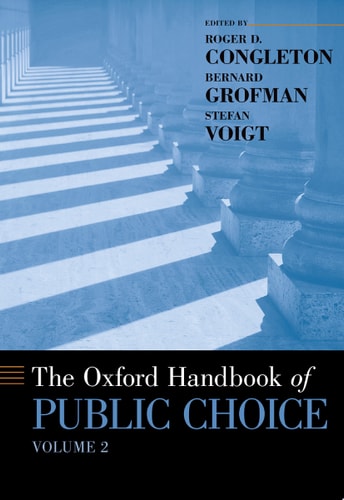
The Oxford Handbook of Public Choice: Volume 2
0
0
As an Amazon Associate and affiliate partner, Menrva Books earns from qualifying purchases. Learn more
Author Description
The Oxford Handbook of Public Choice provides a comprehensive overview of the research in economics, political science, law, and sociology that has generated considerable insight into the politics of democratic and authoritarian systems as well as the influence of different institutional frameworks on incentives and outcomes. The result is an improved understanding of public policy, public finance, industrial organization, and macroeconomics as the combination of political and economic analysis shed light on how various interests compete both within a given rules of the games and, at times, to change the rules. These volumes include analytical surveys, syntheses, and general overviews of the many subfields of public choice focusing on interesting, important, and at times contentious issues. Throughout the focus is on enhancing understanding how political and economic systems act and interact, and how they might be improved.Both volumes combine methodological analysis with substantive overviews of key topics. This second volume examines constitutional political economy and also various applications, including public policy, international relations, and the study of history, as well as methodological and measurement issues.Throughout both volumes important analytical concepts and tools are discussed, including their application to substantive topics. Readers will gain increased understanding of rational choice and its implications for collective action; various explanations of voting, including economic and expressive; the role of taxation and finance in government dynamics; how trust and persuasion influence political outcomes; and how revolution, coups, and authoritarianism can be explained by the same set of analytical tools as enhance understanding of the various forms of democracy.
Menrva's Summary
THE THESIS
This volume investigates the intersection of political and economic analysis to explain how institutional frameworks shape incentives and outcomes in both democratic and authoritarian systems. The editors, Bernard N. Grofman, Roger D. Congleton, and Stefan Voigt, curate a collection of analytical surveys and syntheses from leading scholars in the field. The work posits that rational choice theory provides a robust framework for understanding complex political dynamics, ranging from public finance and industrial organization to the mechanics of revolution and constitutional change.
THE SCOPE MAP
What You Will Find
- Constitutional political economy frameworks
- Applications in international relations and historical analysis
- Methodological approaches to measuring political and economic variables
- Rational choice models applied to collective action and voting behavior
Scope Limits
- Does not provide a singular unified theory but rather a survey of diverse subfields
- Focuses primarily on formal institutional analysis rather than qualitative political theory
THE AUTHORITY PERSPECTIVE
Experts recognize this handbook as a comprehensive reference for researchers and graduate students seeking a rigorous overview of public choice theory. Readers frequently note the academic density of the prose, which assumes a foundational understanding of economic and political modeling.
Page Count:
1016
Publication Date:
2018-01-01
Publisher:
Oxford University Press
ISBN-10:
019046979X
ISBN-13:
9780190469795
Economics
Sociology
Public Policy
Reference
Constitutional Law
Community Tags
Similar Books