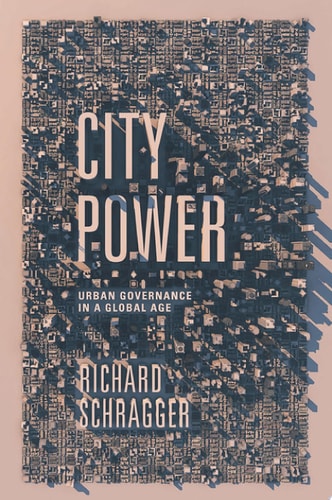
City Power: Urban Governance in a Global Age
0
0
As an Amazon Associate and affiliate partner, Menrva Books earns from qualifying purchases. Learn more
Author Description
In 2013, Detroit filed the largest municipal bankruptcy in US history. That dubious honor marked the end of a long decline, during which city leaders slashed municipal costs and desperately sought to attract private investment. That same year, an economically resurgent New York City elected a progressive mayor intent on reducing income inequality and spurring more equitable economic development. Whether or not Mayor Bill de Blasio realizes his legislative vision, his agenda raises a fundamental question: Can American cities govern, or are they powerless in the face of global capital? Conventional economic wisdom asserts that cities cannot do very much. Conventional political wisdom asserts that cities should not do very much. In City Power, Richard Schragger challenges both these claims, arguing that cities can govern, but only if we let them. In the past decade, city leaders across America have raised the minimum wage, expanded social services, put conditions on incoming development, and otherwise engaged in social welfare redistribution. These cities have not suffered from capital flight - in fact, many are experiencing an economic renaissance. Schragger argues that the range of city policies is not limited by the requirements of capital, but instead by a constitutional structure that serves the interests of state and federal officials. Maintaining weak cities is a political choice. City Power shows how cities can govern despite constitutional limitations - and why we should want them to. In an era of global capital, municipal power is more relevant than ever to citizen well-being. A dynamic vision of city politics for the new urban age, City Power demonstrates that the city should be at the very center of our economic, legal, and political thinking.
Menrva's Summary
THE THESIS
Can American cities effectively govern their own economic and social affairs, or are they inherently powerless against the forces of global capital? Richard Schragger, a professor of law at the University of Virginia, utilizes a combination of legal analysis, historical case studies, and economic theory to challenge the prevailing belief that cities are economically constrained by the requirements of mobile capital. He argues that the perceived weakness of municipal government is not an inevitable economic outcome, but rather a deliberate political and constitutional choice designed to prioritize state and federal authority over local autonomy.
THE SCOPE MAP
What You Will Find
- Analysis of the constitutional and legal frameworks that limit municipal authority in the United States.
- Comparative examination of urban policy outcomes in cities like Detroit and New York.
- Evaluation of local interventions such as minimum wage increases, social service expansion, and development conditions.
Scope Limits
- The text focuses primarily on the American legal and political system and does not provide a global comparative study of international urban governance.
THE AUTHORITY PERSPECTIVE
Scholars and urban policy experts frequently cite this work as a significant challenge to the conventional wisdom regarding the economic limitations of municipal government. Readers often note the academic density of the prose, which requires a foundational understanding of American constitutional law to fully grasp the author's arguments.
Page Count:
288
Publication Date:
2016-01-01
Publisher:
Oxford University Press, Incorporated
ISBN-10:
0190246677
ISBN-13:
9780190246679
Economics
urban planning
Sociology
Constitutional Law
Local government
Public Policy
Labor Movement
Urban policy
Community Tags
Other Editions(2)

Similar Books