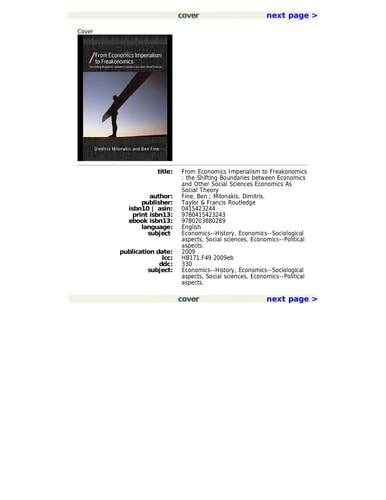
From Economics Imperialism to Freakonomics: The Shifting Boundaries Between Economics and Other Social Sciences
0
0
As an Amazon Associate and affiliate partner, Menrva Books earns from qualifying purchases. Learn more
Author Description
Is or has economics ever been the imperial social science? Could or should it ever be so? These are the central concerns of this book. It involves a critical reflection on the process of how economics became the way it is, in terms of a narrow and intolerant orthodoxy, that has, nonetheless, increasingly directed its attention to appropriating the subject matter of other social sciences through the process termed "economics imperialism". In other words, the book addresses the shifting boundaries between economics and the other social sciences as seen from the confines of the dismal science, with some reflection on the responses to the economic imperialists by other disciplines.Significantly, an old economics imperialism is identified of the "as if market" style most closely associated with Gary Becker, the public choice theory of Buchanan and Tullock and cliometrics. But this has given way to a more "revolutionary" form of economics imperialism associated with the information-theoretic economics of Akerlof and Stiglitz, and the new institutional economics of Coase, Wiliamson and North. Embracing one "new" field after another, economics imperialism reaches its most extreme version in the form of "freakonomics", the economic theory of everything on the basis of the most shallow principles.By way of contrast and as a guiding critical thread, a thorough review is offered of the appropriate principles underpinning political economy and its relationship to social science, and how these have been and continue to be deployed. The case is made for political economy with an interdisciplinary character, able to bridge the gap between economics and other social sciences, and draw upon and interrogate the nature of contemporary capitalism.
Menrva's Summary
THE THESIS
Does the expansion of economic methodology into other social science disciplines represent a legitimate scientific advancement or an intellectual overreach that undermines the integrity of social theory? Ben Fine, a professor of economics, investigates the historical and theoretical trajectory of 'economics imperialism,' a process where economic orthodoxy attempts to colonize the subject matter of sociology, political science, and history. The book provides a rigorous critique of how narrow economic models are applied to complex social phenomena, contrasting this trend with the principles of a more holistic political economy.
THE SCOPE MAP
What You Will Find
- A historical analysis of the 'as if market' approach championed by figures like Gary Becker and the public choice school.
- A critical examination of the 'new' economics imperialism, including information-theoretic models and new institutional economics.
- A detailed assessment of the 'freakonomics' phenomenon as a reductionist application of economic theory to diverse social issues.
- A proposed framework for an interdisciplinary political economy capable of analyzing contemporary capitalism without resorting to methodological imperialism.
THE AUTHORITY PERSPECTIVE
Scholars in the field of heterodox economics recognize this work as a significant critique of mainstream economic expansionism. Readers frequently note the academic density of the prose, which serves as a foundational text for those interested in the intersection of economics and social theory.
Page Count:
216
Publication Date:
2009-04-15
Publisher:
Routledge
ISBN-10:
0203880285
ISBN-13:
9780203880289
Economics
Sociology
Economics
Economics history
Social Science
Community Tags
Similar Books