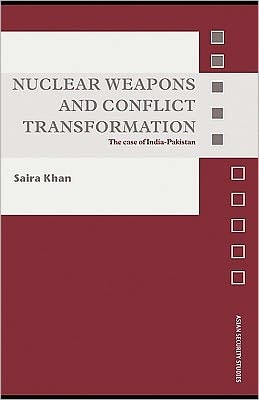
Nuclear Weapons and Conflict Transformation: The Case of India-Pakistan
0
0
As an Amazon Associate and affiliate partner, Menrva Books earns from qualifying purchases. Learn more
Author Description
This new volume explores what the acquisition of nuclear weapons means for the life of a protracted conflict.The book argues that the significance of the possession of nuclear weapons in conflict resolution has been previously overlooked. Saira Khan argues that the acquisition of nuclear weapons by states keeps conflicts alive indefinitely, as they are maintained by frequent crises and low-to-medium intensity violence, rather than escalating to full-scale wars. This theory therefore emphasises the importance of nuclear weapons in both war-avoidance and peace-avoidance. The book opens with a section explaining its theory of conflict transformation with nuclear weapons, before testing this against the case study of the India--Pakistan protracted conflict in South Asia.This book will be of much interest to students of strategic studies, IR and Asian politics and security.
Menrva's Summary
THE THESIS
This book investigates how the acquisition of nuclear weapons fundamentally alters the trajectory of protracted conflicts by preventing both full-scale war and genuine peace. Saira Khan, a scholar in international relations and security studies, presents a theoretical framework that challenges traditional views on nuclear deterrence. She argues that nuclear-armed states in long-standing disputes often settle into a state of perpetual low-to-medium intensity conflict, effectively trapping the involved nations in a cycle of crisis that avoids total destruction but precludes resolution.
THE SCOPE MAP
What You Will Find
- A theoretical framework for conflict transformation in the context of nuclear proliferation.
- An analysis of the dual role of nuclear weapons in both war-avoidance and peace-avoidance.
- A detailed case study of the India-Pakistan protracted conflict in South Asia.
- Examination of how frequent crises sustain geopolitical tensions without escalating to total war.
THE AUTHORITY PERSPECTIVE
Experts in strategic studies and international relations recognize this work as a significant contribution to the literature on South Asian security dynamics. Readers frequently note the academic rigor of the author's argument regarding the paradoxical stability of nuclear-armed rivals.
Page Count:
202
Publication Date:
2008-01-01
Publisher:
Routledge
ISBN-10:
0203891767
ISBN-13:
9780203891766
Conflict Resolution
International relations
Nuclear weapons
Arms Control
Security Studies