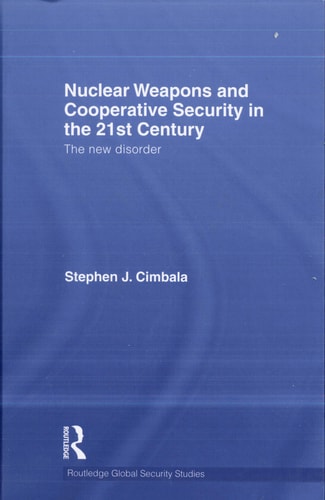
Nuclear Weapons and Cooperative Security in the 21st Century: The New Disorder
0
0
As an Amazon Associate and affiliate partner, Menrva Books earns from qualifying purchases. Learn more
Author Description
This book looks at the prospects for international cooperation over nuclear weapons proliferation in the 21st century.Nuclear weapons served as stabilizing forces during the Cold War, or the First Nuclear Age, on account of their capability for destruction, the fear that this created among politicians and publics, and the domination of the nuclear world order by two superpowers: the United States and the Soviet Union. The end of the Cold War, the dissolution of the Soviet Union, and the potential for nuclear weapons acquisition among revisionist states, or even non-state actors including terrorists, creates the possibility of a 'wolves eat dogs' phenomenon in the present century.In the 21st century, three forces threaten to undo or weaken the long nuclear peace and fast-forward states into a new and more dangerous situation: the existence of large US and Russian nuclear weapons arsenals; the potential for new technologies, including missile defenses and long-range, precision conventional weapons, and a collapse or atrophy of the nuclear nonproliferation regime, and the opening of the door for nuclear weapons to spread among more than the currently acknowledged nuclear states.This book explains how these three 'weakening' forces interact with one another and with US and Russian policy-making in order to create an environment of large possibilities for cooperative security - but also of considerable danger. Instead, the choices made by military planners and policy-makers will create an early twenty-first century story privileging nuclear stability or chaos. The US and Russia can, and should, make incremental progress in arms control and nonproliferation.This book will be of much interest to students of nuclear proliferation and arms control, strategic studies, international security and IR in general.Stephen J. Cimbala is Distinguished Professor of Political Science at Pennsylvania State University. He is the author of numerous works in the fields of international sec
Menrva's Summary
THE THESIS
This book investigates whether international cooperation can effectively manage nuclear proliferation and maintain stability in the increasingly volatile geopolitical landscape of the 21st century. Stephen J. Cimbala, a Distinguished Professor of Political Science, utilizes historical analysis of the Cold War nuclear order to contrast it with the current era of multipolar threats. He argues that the interaction between existing superpower arsenals, emerging military technologies, and the erosion of nonproliferation regimes creates a critical juncture for global security policy.
THE SCOPE MAP
What You Will Find
- Comparative analysis of the First Nuclear Age versus the current 21st-century security environment.
- Examination of the impact of missile defense systems and precision conventional weaponry on nuclear deterrence.
- Evaluation of the risks posed by revisionist states and non-state actors in the absence of a bipolar nuclear order.
- Strategic framework for US and Russian policy-making regarding arms control and nonproliferation.
THE AUTHORITY PERSPECTIVE
Experts identify this work as a significant contribution to strategic studies, noting its clear articulation of the risks inherent in the post-Cold War nuclear landscape. Readers frequently highlight the author's ability to synthesize complex geopolitical dynamics into a coherent argument for cooperative security.
Page Count:
208
Publication Date:
2009-01-01
Publisher:
Routledge
ISBN-10:
0203870646
ISBN-13:
9780203870648
Security Studies
Arms Control
Military Strategy
Nuclear weapons
International relations
Community Tags
Other Editions(2)

Similar Books

Reader Comments
Share Your Thoughts
No comments yet. Be the first to share your thoughts!