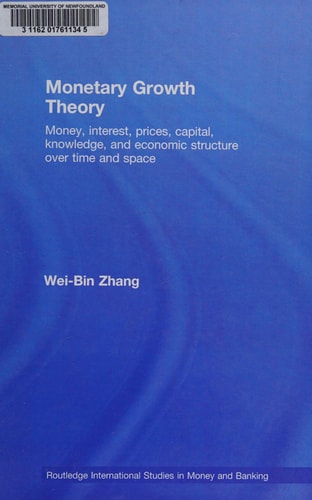
Monetary Growth Theory: Money, Interest, Prices, Capital, Knowledge and Economic Structure Over Time and Space
0
0
As an Amazon Associate and affiliate partner, Menrva Books earns from qualifying purchases. Learn more
Author Description
This book answers some challenging questions in monetary growth theory within a compact theoretical framework. The author succeeds in integrating the theory of money, the theory of value and the theory of growth. The book re-examines many important ideas in modern monetary economics within a single analytical framework. It is concerned not only with traditional one-sector growth models of a homogeneous population with endogenous capital and knowledge, but also with multi-sector models, economies with heterogeneous households, and economies with urban structures, interregional interactions and international trade. Zhang’s book will appeal to those studying monetary economics, neoclassical growth theory, development economics and international economics. It is also useful more generally, for researchers in social sciences with an interest in the role of money in modern societies.
Menrva's Summary
THE THESIS
This book investigates the integration of monetary theory, value theory, and growth theory within a unified analytical framework to explain economic structure over time and space. Wei-Bin Zhang, an established scholar in economic modeling, utilizes a rigorous mathematical approach to synthesize disparate concepts in modern monetary economics. By moving beyond traditional one-sector models, the author constructs a comprehensive system that accounts for endogenous capital, knowledge accumulation, and complex spatial interactions.
THE SCOPE MAP
What You Will Find
- Multi-sector growth models incorporating heterogeneous households and urban structures.
- Analysis of interregional interactions and international trade dynamics.
- Integration of money, interest rates, and price levels into neoclassical growth frameworks.
- Mathematical modeling of endogenous capital and knowledge accumulation.
THE AUTHORITY PERSPECTIVE
Experts identify this work as a dense, technical resource for researchers and advanced students of neoclassical growth and development economics. Readers frequently note the high level of mathematical sophistication required to engage with the author's integrated analytical models.
Page Count:
400
Publication Date:
2008-01-01
Publisher:
Routledge
ISBN-10:
0203894332
ISBN-13:
9780203894330
Economics
Macroeconomics
Money
Monetary Economics
Community Tags
Similar Books