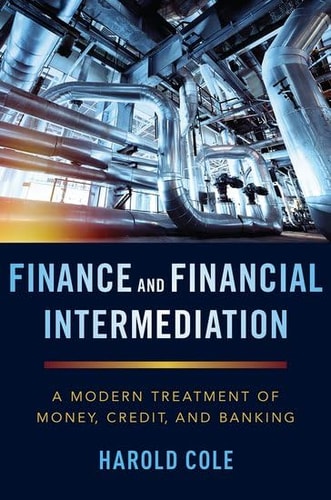
Finance and Financial Intermediation: A Modern Treatment of Money, Credit, and Banking
0
0
As an Amazon Associate and affiliate partner, Menrva Books earns from qualifying purchases. Learn more
Author Description
The financial system is a densely interconnected network of financial intermediaries, facilitators, and markets that serves three major purposes: allocating capital, sharing risks, and facilitating intertemporal trade. Asset prices are an important mechanism in each of these phenomena. Capital allocation, whether through loans or other forms of investment, can vary both across sectors-at the broadest, manufactures, agriculture, and services-and within sectors, for example different firms. The risk that various investors are willing to take reflects their financial position and alternative opportunities. Risk and asset allocation are also influenced by whether money, and especially its expenditure, is more important now or in the future. These decisions are all influenced by governmental policies. When there are mismatches, the results include financial meltdowns, fiscal deficits, sovereign debt, default and debt crises.Harold L. Cole provides a broad overview of the financial system and assets pricing, covering history, institutional detail, and theory. The book begins with an overview of financial markets and their operation and then covers asset pricing for standard assets and derivatives, and analyzes what modern finance says about firm behavior and capital structure. It then examines theories of money, exchange rates, electronic payments methods, and cryptocurrencies. After exploring banks and other forms of financial intermediation, the book examines the role they played in the Great Recession. Having provided an overview of the provate sector, Cole switches to public finance and government borrowing as well as the incentives to monetize the public debt and its consequences. The book closes with an examination of sovereign debt crises and an analysis of their various forms.Finance and financial intermediation are central to modern economies. This book covers all of the material a sophisticated economist needs to know about this area.
Menrva's Summary
THE THESIS
This text investigates the core functions of the financial system, specifically how capital allocation, risk sharing, and intertemporal trade interact within modern economies. Harold L. Cole, an economist, utilizes a combination of historical analysis, institutional detail, and formal theory to construct a comprehensive framework for understanding financial systems. The book examines how asset pricing, firm behavior, and government policy collectively influence economic stability and the occurrence of financial crises.
THE SCOPE MAP
What You Will Find
- Theoretical foundations of asset pricing for standard assets and derivatives
- Analysis of modern firm behavior and capital structure
- Examination of monetary theory, electronic payments, and cryptocurrencies
- Historical and theoretical overview of banking and financial intermediation
- Analysis of public finance, sovereign debt, and the Great Recession
Scope Limits
- The text assumes a high level of economic literacy and does not serve as an introductory primer for laypeople
- It focuses primarily on macroeconomic and systemic perspectives rather than personal financial management
THE AUTHORITY PERSPECTIVE
Experts identify this work as a comprehensive resource for advanced students and professionals seeking a rigorous synthesis of modern financial theory. Readers frequently note the academic density of the prose, which is designed for those already possessing a sophisticated understanding of economic principles.
Page Count:
264
Publication Date:
2019-04-30
Publisher:
Oxford University Press
ISBN-10:
0190941693
ISBN-13:
9780190941697
Economics
Banking
Finance
Macroeconomics
Community Tags
Other Editions(2)
Similar Books







Reader Comments
Share Your Thoughts
No comments yet. Be the first to share your thoughts!