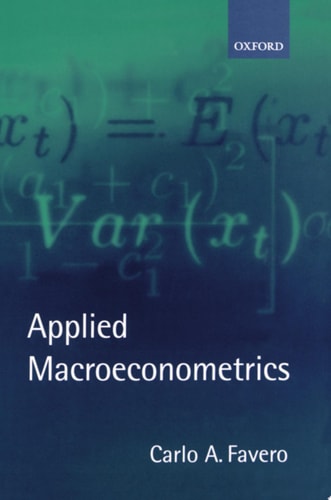
Applied Macroeconometrics
0
0
As an Amazon Associate and affiliate partner, Menrva Books earns from qualifying purchases. Learn more
Author Description
This text provides graduate students of macroeconomics, econometrics, and monetary economics with discussion and practical illustrations of the techniques used in applied macroeconometrics. Until the 1970s, there was consensus regarding both the theoretical foundations and the empirical specification of applied macroeconometric modelling, commonly known as the Cowles Commission approach. This is no longer the case: the Cowles Commission approach broke down in the 1970s, to be replaced by a number of prominent competing methods--the LSE (London School of Economics) approach, the VAR approach, and the intertemporal optimization/Real Business Cycle approach. Applied Macroeconometrics examines the empirical research strategy of these alternatives by interpreting them as attempts to solve the problems observed in the Cowles Commission approach. The different research strategies are illustrated with specific reference to real-world examples, particularly with respect to the monetary transmission mechanism. A common US dataset is used in these examples, thus allowing the reader easy comparisons. The presentation is based on the view that identification, a central concept in econometrics, provides a natural framework in which to discuss the alternative strategies currently dominating research. The first part of the book introduces time-series models and details the importance of their identification. The second part illustrates, chapter by chapter, the alternative approaches, providing detailed applications of each methodology. Data used in the applications are available in a variety of formats from the author's web site, and will be supplemented by exercises for the reader to perform.
Menrva's Summary
THE THESIS
This text investigates the evolution of empirical research strategies in macroeconometrics following the decline of the Cowles Commission approach in the 1970s. Carlo A. Favero, a professor of economics, utilizes his expertise to evaluate how competing methodologies—specifically the LSE approach, the VAR approach, and the intertemporal optimization/Real Business Cycle approach—address the identification problems inherent in earlier models. By framing these strategies through the lens of identification, the author provides a structured analytical framework for understanding modern empirical research in monetary economics.
THE SCOPE MAP
What You Will Find
- Comparative analysis of the Cowles Commission, LSE, VAR, and Real Business Cycle methodologies
- Technical examination of time-series models and identification frameworks
- Practical applications focused on the monetary transmission mechanism
- Consistent use of a common US dataset for comparative modeling
Scope Limits
- The text assumes a foundational knowledge of graduate-level macroeconomics and econometrics
- It does not provide an exhaustive history of all economic thought, focusing strictly on empirical modeling strategies
THE AUTHORITY PERSPECTIVE
Experts and graduate students frequently identify this work as a standard reference for understanding the transition between competing econometric research programs. Readers often note the technical density of the prose, which requires a strong background in statistical theory to fully grasp the methodological comparisons.
Page Count:
296
Publication Date:
2001-01-01
Publisher:
Oxford University Press
ISBN-10:
0191001864
ISBN-13:
9780191001864
Economics
Econometrics
Academic Textbooks
Monetary Economics
Quantitative Methods
Principles of Macroeconomics
Macroeconomics
Community Tags
Similar Books