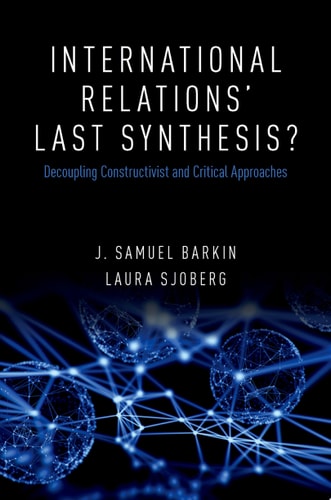
International Relations' Last Synthesis?
0
0
As an Amazon Associate and affiliate partner, Menrva Books earns from qualifying purchases. Learn more
Author Description
Many scholars, intentionally or unintentionally, have entangled constructivisms and critical theories in problematic ways, either by assigning a critical-theoretical politics to constructivisms or by assuming the appropriateness of constructivist epistemology and methods for critical theorizing. IR's Last Synthesis? makes the argument that these connections mirror IR's grand theoretical syntheses of the 1980s and 1990s and have similar constraining effects on the possibilities of IR theory. They have been made without adequate reflection, in contradiction to the base assumptions of each theoretical perspective, and to the detriment of both knowledge accumulation about global politics and theoretical rigor in disciplinary IR. It is not that constructivisms and critical theories have no common ground; rather, the fact that it has become routine for IR scholars to overstate their common ground is counterproductive to the discovery and utilization of their potential dialogues. To that end, IR's Last Synthesis? argues that scholars using the two in conjunction should be cognizant of, rather than gloss over, the tensions between the approaches and the tools they have to offer. Along these lines, the book uses the concept of affordances to look at what each has to offer the other, and to argue for a modest, reflective, specified return to (constructivist and critical) IR theorizing. By rejecting its over-simple syntheses, this book hews a road toward reviving IR theorizing.
Menrva's Summary
THE THESIS
Does the routine conflation of constructivism and critical theory in International Relations scholarship hinder the development of rigorous political theory? Authors J. Samuel Barkin and Laura Sjoberg, both established scholars in the field, argue that the unreflective synthesis of these two paradigms mirrors the restrictive theoretical trends of the 1990s. They contend that by ignoring the fundamental tensions between these approaches, the discipline limits its capacity for genuine knowledge accumulation and theoretical innovation.
THE SCOPE MAP
What You Will Find
- A critique of the current disciplinary habits regarding theoretical synthesis in International Relations.
- The application of the concept of 'affordances' to evaluate the utility of constructivism and critical theory.
- A proposed framework for a more reflective and specified approach to combining these theoretical tools.
Scope Limits
- The text does not provide a comprehensive history of all International Relations theories.
- It does not offer a singular, unified theory to replace existing paradigms.
THE AUTHORITY PERSPECTIVE
Scholars in the field recognize this work as a significant intervention in the meta-theoretical debates of International Relations. Readers frequently note the high level of academic density and the authors' rigorous demand for conceptual precision in theoretical application.
Page Count:
240
Publication Date:
2019-01-01
Publisher:
Oxford University Press
ISBN-10:
0190463430
ISBN-13:
9780190463434
Philosophy
Political Theory
Academic
International relations
Community Tags
Similar Books