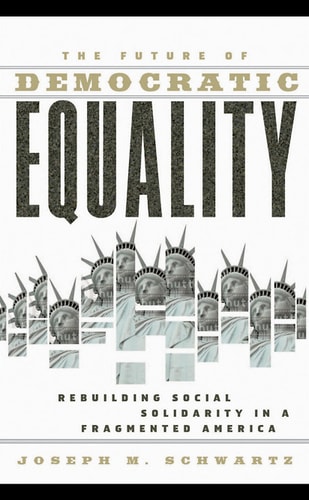
The Future of Democratic Equality: Rebuilding Social Solidarity in a Fragmented America
0
0
As an Amazon Associate and affiliate partner, Menrva Books earns from qualifying purchases. Learn more
Author Description
2011 David Easton Award, presented for the best book by the Foundations of Political Theory section of APSA: "The Future of Democratic Equality, by Joseph Schwartz, takes on three tasks, and accomplishes all brilliantly. Any one of these tasks well fulfilled would have been a laudable achievement. First, Schwartz argues for the centrality of the question of equality to democratic politics. Second, he critically analyzes and explains the shocking rise in inequality in the United States over the last three decades. This he does with conceptual clarity, rich interdisciplinary analysis, and a thorough examination of hard socioeconomic data. Third, he assails the near absence of concern for this soaring inequality among contemporary political theorists, and offers a cogent, and stinging, explanation that takes to task the discipline’s preoccupation with difference and identity severed from the pragmatics of democratic equality. The Future of Democratic Equality is a courageous and disciplined effort to tackle a hugely important political problem and intellectual puzzle. It well embodies the spirit of the Easton Book Award by providing well-grounded normative theory targeted to an urgent matter of contemporary concern. It is a must read for anyone who cares about democracy." - Respectfully submitted by Leslie Paul Thiele, University of Florida (chair) and Cary J. Nederman, Texas A&M UniversityWhy has contemporary radical political theory remained virtually silent about the stunning rise in inequality in the United States over the past thirty years? Schwartz contends that since the 1980s, most radical theorists shifted their focus away from interrogating social inequality to criticizing the liberal and radical tradition for being inattentive to the role of difference and identity within social life. This critique brought more awareness of the relative autonomy of gender, racial, and sexual oppression. But, as Schwartz argues, it also led many theorists to forget that if d
Menrva's Summary
THE THESIS
This book investigates why contemporary radical political theory has largely failed to address the significant rise in socioeconomic inequality within the United States over the last thirty years. Joseph M. Schwartz, a professor of political science, utilizes an interdisciplinary approach that combines socioeconomic data with normative political theory. He argues that the academic shift toward identity politics has inadvertently sidelined the material conditions necessary for maintaining democratic equality. By critiquing this intellectual trend, he provides a framework for reconnecting social solidarity with the broader goals of a democratic society.
THE SCOPE MAP
What You Will Find
- Analysis of socioeconomic data regarding wealth and income distribution in the United States since the 1980s.
- A critique of contemporary political theory's focus on identity and difference at the expense of material equality.
- Examination of the historical relationship between social solidarity and democratic stability.
- Theoretical arguments for integrating the politics of recognition with the politics of redistribution.
THE AUTHORITY PERSPECTIVE
Experts and political theorists recognize this work as a significant contribution to the field, noting its rigorous normative analysis and its challenge to prevailing academic trends. Readers frequently highlight the text's dense, scholarly prose and its success in bridging the gap between abstract political theory and urgent contemporary socioeconomic issues.
Page Count:
240
Publication Date:
2008-01-01
Publisher:
Routledge
ISBN-10:
0203894324
ISBN-13:
9780203894323
Economics
Equality
Political Theory
Democracy
Solidarity
Sociology
Community Tags
Similar Books