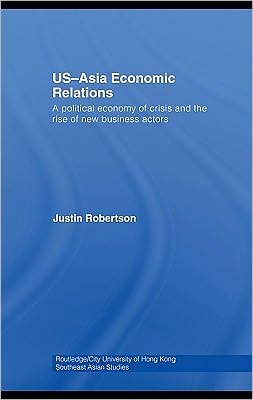
US-Asia Economic Relations: A Political Economy of Crisis and the Rise of New Business Actors
0
0
As an Amazon Associate and affiliate partner, Menrva Books earns from qualifying purchases. Learn more
Author Description
In a world of continuing financial volatility, this book critically evaluates the oft-cited claim that US firms and the US government attempt to open emerging markets in economic distress and acquire valuable industrial and financial assets.Focusing particularly on Korea and Thailand, the author examines the degree of market opening, the roles US actors played in this process and the level of foreign firm activity in the years after the Asian crisis. Justin Robertson finds surprisingly little coherence between the strategies of US firms and US policy-makers. At the same time, the book downplays European investments, concluding instead that the decade since the Asian crisis has reaffirmed strengths of US capital, particularly in some of the most important sectors of the global economy. Investment banking, private equity and subcontracting are significant new features of US-Asia economic relations.Providing a sophisticated understanding of US interests in Asia, especially in terms of the politics of finance capital, and including a wealth of empirical data on the US and Asian political economies, this book will be invaluable for students and scholars of international political economy and Asian economics and politics.
Menrva's Summary
THE THESIS
This book investigates the extent to which US government policy and corporate strategy align to exploit emerging markets during periods of economic distress. Justin Robertson, a scholar of international political economy, utilizes empirical data from the post-Asian financial crisis period to challenge the assumption that US firms and policy-makers act in a coordinated fashion to acquire distressed assets. By analyzing the specific economic landscapes of Korea and Thailand, the author argues that the relationship between US capital and Asian markets is more complex and less coherent than traditional political economy models suggest.
THE SCOPE MAP
What You Will Find
- Comparative analysis of market opening strategies in Korea and Thailand post-1997.
- Examination of the roles played by investment banking, private equity, and subcontracting firms.
- Empirical data sets tracking foreign firm activity and asset acquisition trends.
- Theoretical framework evaluating the influence of US policy-makers versus private corporate interests.
THE AUTHORITY PERSPECTIVE
Experts in international political economy identify this work as a rigorous contribution to the study of US-Asia financial relations. Readers frequently note the academic density of the prose and the value of the author's nuanced findings regarding the lack of strategic coherence between state and private actors.
Page Count:
252
Publication Date:
2008-01-01
Publisher:
Routledge
ISBN-10:
0203890523
ISBN-13:
9780203890523
Economics
International relations
Asian Studies
Asia
Finance
United States