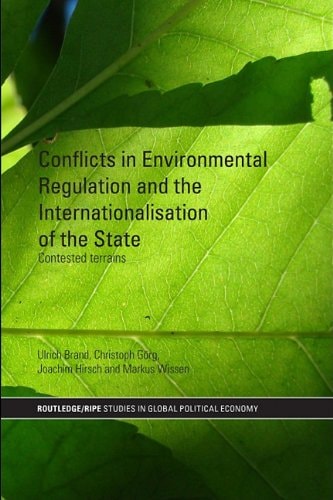
Conflicts in Environmental Regulation and the Internationalization of the State: Contested Terrains
0
0
As an Amazon Associate and affiliate partner, Menrva Books earns from qualifying purchases. Learn more
Author Description
This book examines the global regulation of biodiversity politics through the UN Convention on Biological Diversity (CBD), the WTO and other international treaties. Using historical-materialist state and regulation theory, it assesses how the discourse and politics of sustainable development have contributed to the internationalisation of the state. The authors argue that sustainable development, far from being a fixed concept, is a conceptual terrain on which different and conflicting symbolisations of and solutions responses to of the ecological crisis struggle for hegemony. Furthermore, it shows that the international multilateral environmental organisations agreements are not at all a means to counteract neoliberal globalisation but, on the contrary, form an integral part of the ongoing transformation process. Focussing on the UN Convention on Biological Diversity, the FAO International Treaty on Plant Genetic Resources for Food and Agriculture and the Agreement on Trade-related Aspects of Intellectual Property Rights (TRIPS) in the World Trade Organisation, this co-authored volume addresses the following issues: state theory, regulation theory and International Political Economy biodiversity protection and valorisation of genetic resources access to genetic resources and sharing of benefits which arise out of its use enforcement of intellectual property rights and their impact on biodiversity. This book will be of interest to students and scholars of international politics, international political economy, environmental studies, development studies and political ecology.
Menrva's Summary
THE THESIS
This book investigates how international environmental regulations, specifically regarding biodiversity, function as a mechanism for the internationalization of the state within the context of neoliberal globalization. Ulrich Brand utilizes a historical-materialist framework to analyze how sustainable development serves as a contested conceptual terrain rather than a static policy goal. By examining key international agreements, the author argues that these frameworks often reinforce rather than mitigate the structural dynamics of global neoliberalism.
THE SCOPE MAP
What You Will Find
- Analysis of the UN Convention on Biological Diversity and the FAO International Treaty on Plant Genetic Resources.
- Application of historical-materialist state and regulation theory to international environmental politics.
- Examination of the intersection between intellectual property rights and biodiversity conservation.
- Assessment of how multilateral environmental agreements facilitate the transformation of state functions.
THE AUTHORITY PERSPECTIVE
Scholars in political ecology and international political economy frequently cite this work for its rigorous application of state theory to environmental governance. It is considered a dense, foundational text for those analyzing the structural contradictions inherent in global sustainability initiatives.
Page Count:
304
Publication Date:
2008-01-01
Publisher:
Routledge
ISBN-10:
0203928504
ISBN-13:
9780203928509
Politics
International relations
Specific Topics
Globalization
Sustainability
Community Tags
Similar Books