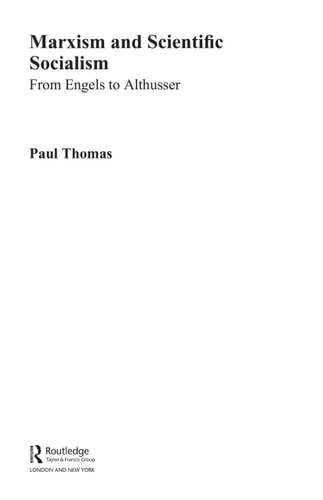
Marxism & Scientific Socialism: From Engels to Althusser
0
0
As an Amazon Associate and affiliate partner, Menrva Books earns from qualifying purchases. Learn more
Author Description
Engels declared at Marx’s funeral in Highgate Cemetery that "just as Darwin discovered the law of development of organic nature, so Marx discovered the law of development of human history". Scientific socialism was the term Engels used to describe Marx's socio-economic philosophy and many later theorists sought to reinforce Marxist theory with a supposedly scientific basis.This book explains the development of the idea of scientific socialism through the 19th and 20th century from its origins in Engels to its last manifestation in the work of Althusser. It provides a detailed analysis of Engel's own conceptualisation, the impact of Darwin, the relationship to the 'official' historical materialism of the Soviet states and later reformulations by Althusser and others. In so doing it provides a vivid intellectual history of Marxist and socialist thought, exploring its significant insights as well its manifest failures.Marxism and Scientific Socialism will be of particular interest to those with an interest in the development of Marxism and socialism, political ideologies and the history of Western political thought.
Menrva's Summary
THE THESIS
This book investigates the historical evolution and theoretical validity of the concept of scientific socialism as it transitioned from the foundational writings of Friedrich Engels to the structuralist interpretations of Louis Althusser. Paul Lindsley Thomas examines how Marxist theorists attempted to ground their socio-economic philosophy in a scientific framework analogous to Darwinian evolutionary theory. By tracing this trajectory through the 20th century, the author evaluates the intellectual rigor of these claims and the eventual divergence between theoretical Marxism and the state-sanctioned historical materialism of the Soviet era.
THE SCOPE MAP
What You Will Find
- A comprehensive analysis of Friedrich Engels' original conceptualization of scientific socialism.
- An examination of the influence of Darwinian evolutionary biology on 19th-century socialist thought.
- A critical review of the 'official' historical materialism adopted by Soviet state institutions.
- An exploration of the later reformulations of Marxist theory provided by Louis Althusser and his contemporaries.
THE AUTHORITY PERSPECTIVE
Scholars and students of political theory frequently identify this work as a useful synthesis for understanding the shifting definitions of scientific socialism over two centuries. Readers often note the text's ability to bridge the gap between early foundational Marxist thought and later, more complex structuralist critiques.
Page Count:
192
Publication Date:
2008-01-01
Publisher:
Routledge
ISBN-10:
0203927311
ISBN-13:
9780203927311
History
Philosophy
Marxism
Intellectual History
Socialism
Community Tags
Similar Books